
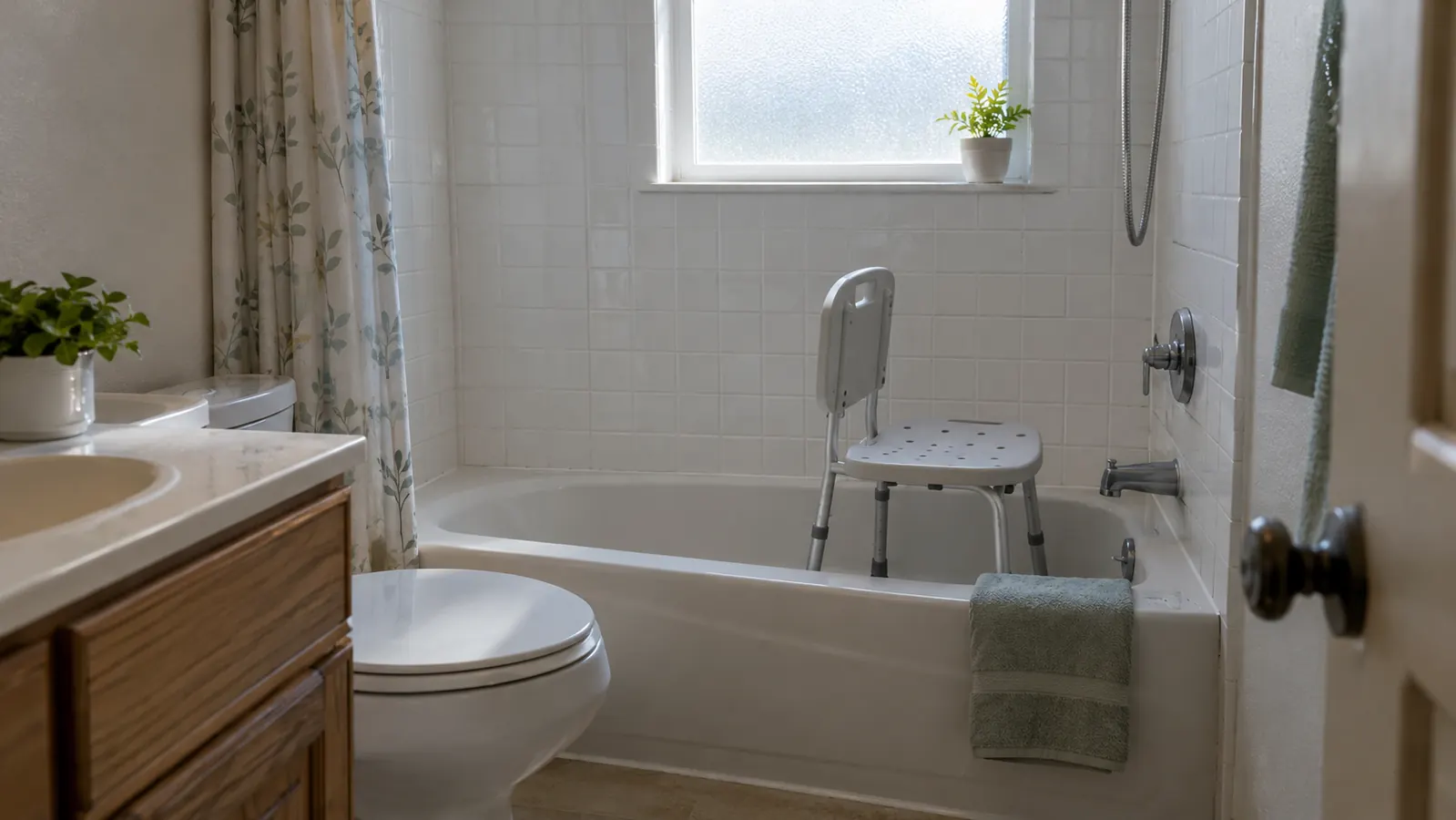
The first time I put a shower chair in our tub, I set it in crooked, sat down, and spent the entire shower with one hand braced against the tile. Nothing was wrong with the chair. I had the order of operations wrong. I spent thirty-one years as a machinist, and one thing that trade drills into you is that a setup done in the right sequence takes five minutes, while the same setup done in whatever sequence you feel like takes an hour and a half and a scrap part. A shower chair in a tub shower combo is the same kind of job.
The chair in our hall bathroom now is the Dr. Kay's shower chair for inside the shower. Aluminum frame, 2.1 kg, a seat that measures 16.7 inches by 10.5 inches, five height settings, and side handles built into the frame. It has been sitting in that tub long enough that I no longer think about it, which is the highest compliment I can pay a piece of equipment. But the chair is the easy half. The other half is where you put it, how high you set it, and what else in that bathroom has to move before the chair is any real use to you.
The chair that sits down inside a standard tub and stays where you put it
Aluminum frame, five height settings from 13.4 to 18.5 inches, a 16.7 by 10.5 inch seat, and side handles built into the frame. The spec sheet rates it to 350 pounds.
Amazon Check Today's Price on Amazon →Step 1: Measure the tub floor before you order anything
The inside floor of a tub is not as wide as the outside of the tub, and it is narrower at the bottom than it is at the rim. Measure the flat part of the floor, wall to wall, at the end where you plan to sit. Ours is a hair under 24 inches. Then measure the rim at the top and write that number down too. Take both numbers with you when you shop, because a chair that fits the rim and not the floor will rock, and a rocking chair in a wet tub is worse than no chair at all.
Then measure yourself. Sit on a hard kitchen chair with your feet flat on the floor, slide a tape measure under your backside, and see how much of the seat you actually cover. The seat on this chair is 16.7 inches by 10.5 inches, which is about what a dining chair gives you. If your tub floor is 20 inches across and the seat is 16.7, you have better than an inch and a half of play on each side to get it centered, and that is enough to work with.
One more thing people forget. The floor of a tub slopes toward the drain, sometimes a quarter inch over the length of it. That slope is why a chair set loose will creep. Set the chair with the slope in mind, get it level enough that it does not want to walk, and put a hand on it every couple of weeks to check. Mine has not moved. But I check.
Step 2: Decide which way the chair faces, then clear the deck
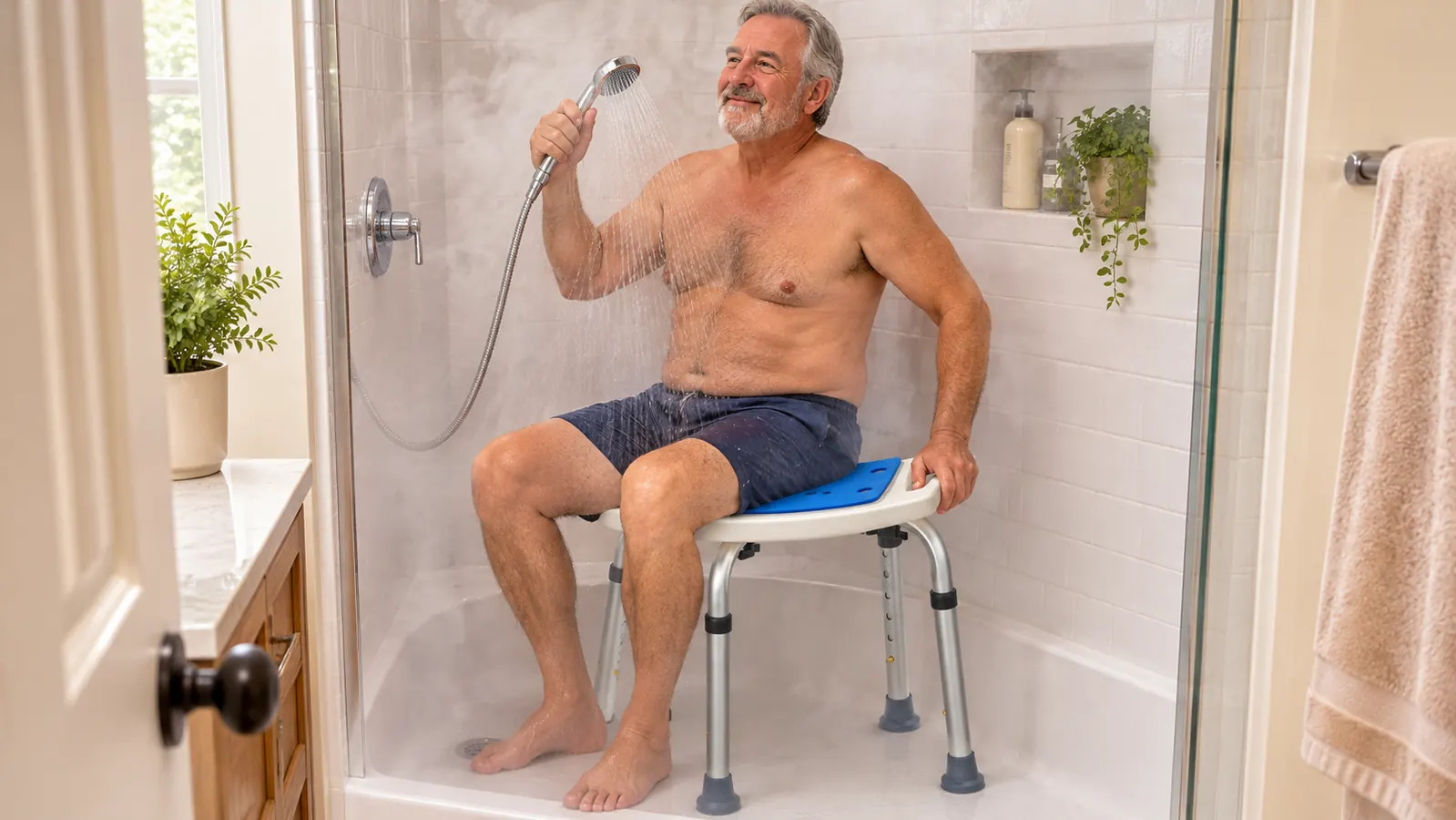
I set ours facing the showerhead wall, with my legs running down the length of the tub toward the drain end. That way I can reach the handles without twisting my back, and I am not sitting sideways with my knees jammed against the wall. Your tub may want the opposite. Get in the empty tub, sit down on the floor of it where the chair will go, and see which direction lets you reach everything without turning.
Then clear the tub deck. Every bottle of shampoo, the razor, the bar of soap, the loofah, all of it comes off the rim and goes into a caddy hanging from the showerhead or onto a shelf within reach. You are going to be sitting down and standing up in a wet space with one hand on a handle, and you do not want to be reaching over the edge of the tub for a bottle at the same time.
Get the loose bath mat out from under the chair legs. A mat is fine on the floor outside the tub. Under the legs it is a sliding layer between you and the tub, and it serves no purpose there. If you want something on the tub floor for comfort, it goes down where your feet land, not where the chair sits.
Step 3: Set the leg height with the chair still on dry land
This is the step I got wrong, and it is the one that matters most. The right height puts your feet flat on the tub floor with your knees bent at about a right angle and your thighs level. Too low and you have to push yourself up out of a hole. Too high and your feet dangle and you slide forward. Neither one is safe in a wet tub.
Here is how to find it without guessing. Sit on a hard chair, feet flat on the floor, and have somebody measure from the floor straight up to the crease behind your knee. That number is your seat height. The Dr. Kay's chair gives you 13.4, 14.4, 15.4, 17.2 and 18.5 inches to pick from, so you take the setting at or just under your number. If you land between two of them, take the lower one. A seat two tenths of an inch low is a small nuisance. A seat that leaves your heels off the floor is a fall waiting on a bad morning.
Set all four legs to the same setting, and do it in the bedroom on the carpet, not while standing in the tub. Then stand the chair on a hard floor, put both hands on the seat, and push down hard. Listen for anything that ticks or shifts. All four legs should carry weight evenly. If one rocks, one leg is on a different setting than the other three, and you go back and fix it before it ever sees water.
Once you find your setting, write it down. I keep mine on a piece of masking tape on the inside of the medicine cabinet door, along with the date I set it. Sounds fussy. But if a leg gets bumped, or somebody in the house decides to help by adjusting it for you, you want the number handy. It also tells you which setting you were on if you ever loan the chair out and get it back.
A seat two tenths of an inch low is a nuisance. A seat that leaves your heels off the floor is a fall waiting on a bad morning.
Step 4: Lower it into the tub without wrecking your back
The whole chair weighs 2.1 kg, a bit over four and a half pounds, so this is not a heavy lift. It is a reach, and reaching is what puts people on the floor. Do not stand outside the tub holding the chair out at arm's length and bend over the rim with it. Set the far side of the chair on the tub floor first, with the chair tilted, the two far legs down and the two near legs still up on the rim. Then walk the near legs down into the tub one at a time.
If you have somebody in the house, have them hand it to you after you are already standing in the tub holding the wall. That is the easiest version, and it is the one I use when Joan is home. When she is not, I do it from outside the tub before I ever step in, which means the chair is already sitting where it belongs and both my hands are free for the wall.
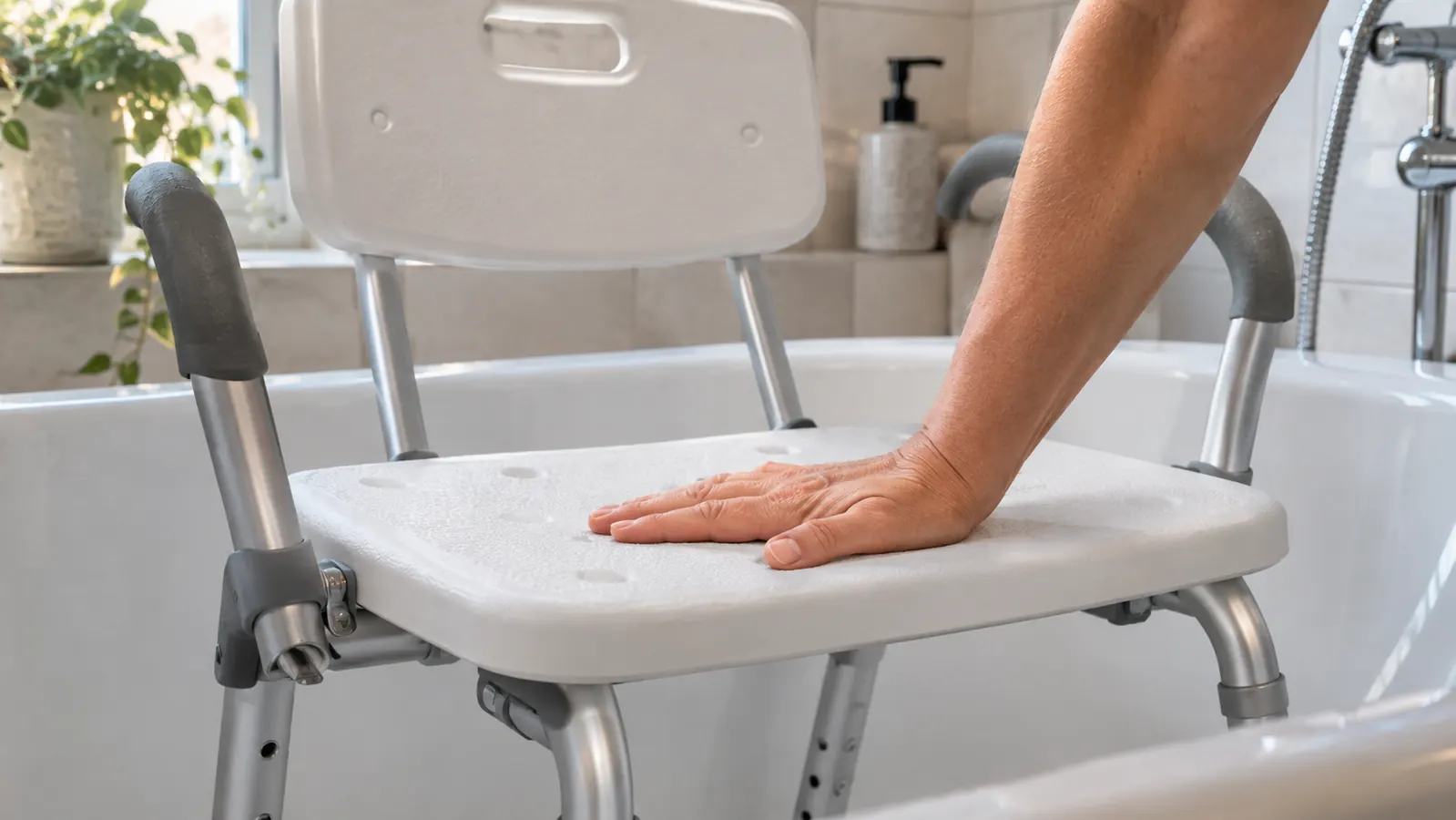
Once it is in, put both hands flat on the seat and lean on it, hard, from outside the tub. Put some real weight into it. If the chair skids or tips, take it out and start again. And understand what you bought. The spec sheet rates this one to 350 pounds, though the listing title says 300, so I would plan on 300 and keep the margin. It is a chair. Do not stand on the seat to reach the showerhead.
Step 5: Rehearse the sit and the stand before you get wet
Back up to the chair until the backs of your legs touch the front edge of the seat. Reach back and put one hand on the side handle, not on the wall, then lower yourself slow. The side handles on the Dr. Kay's chair are built into the frame, one on each side, and they are the reason I stopped bracing against the tile. Your hand goes back and down, you find the handle without looking, and you sit.
Practice it dry, with clothes on, three times before you ever turn the water on. Stand up the same way, one hand on the handle, push through your feet, come up slow. Three times dry is worth more than thirty seconds of figuring it out while soap runs into your eyes. That side handle is also handy for holding a handheld showerhead, which is the other thing you are going to want in there.
The last part of the rehearsal is the part nobody practices, which is getting out. Turn yourself toward the outside of the tub, get both feet over the edge and flat on the mat, and only then stand up. One foot in the tub and one on the floor, with your weight split between them, is how people end up on the tile.
What Else Helps
The chair is the center of the setup, but it does not fix the bathroom by itself. The three things that did the most for me were a handheld showerhead on a slide bar so I am not twisting to rinse, a grab bar on the wall by the tub that is bolted into studs and not stuck on with adhesive, and a night light in the hall so I am not walking into that bathroom half awake in the dark. None of those are fancy and none of them are optional in my book.
Put a towel where you can reach it from a seated position, not hanging on the far wall. Keep the floor mat flat and replace it when the backing starts to curl. And leave the bathroom door unlocked. Joan and I agreed on that after the fall I took in the garage, and it is one of those small agreements that costs nothing and might matter a great deal.
One small thing that helped more than I expected: a fabric shower liner instead of a stiff vinyl one. The vinyl liner used to bell out and stick to my arm every time I moved, and the fabric one hangs and stays where it hangs. If your liner is the stiff kind and it keeps grabbing at you, swap it before you decide the chair does not work.
And one more thing, which I mean. Have your physical therapist look at the setup. Mine watched me get in and out of the tub once, moved the chair about two inches, and told me to change which hand I use on the handle. Two inches. I would not have found that on my own in a hundred years. I am a retired machinist, not a doctor, and the fitting questions belong to the people who do that for a living.
Measure once, set it once, and quit bracing yourself on the tile
Five height settings from 13.4 to 18.5 inches, a 16.7 by 10.5 inch seat, side handles built into the frame, and an aluminum body that weighs 2.1 kg.
Amazon Check Today's Price on Amazon →