
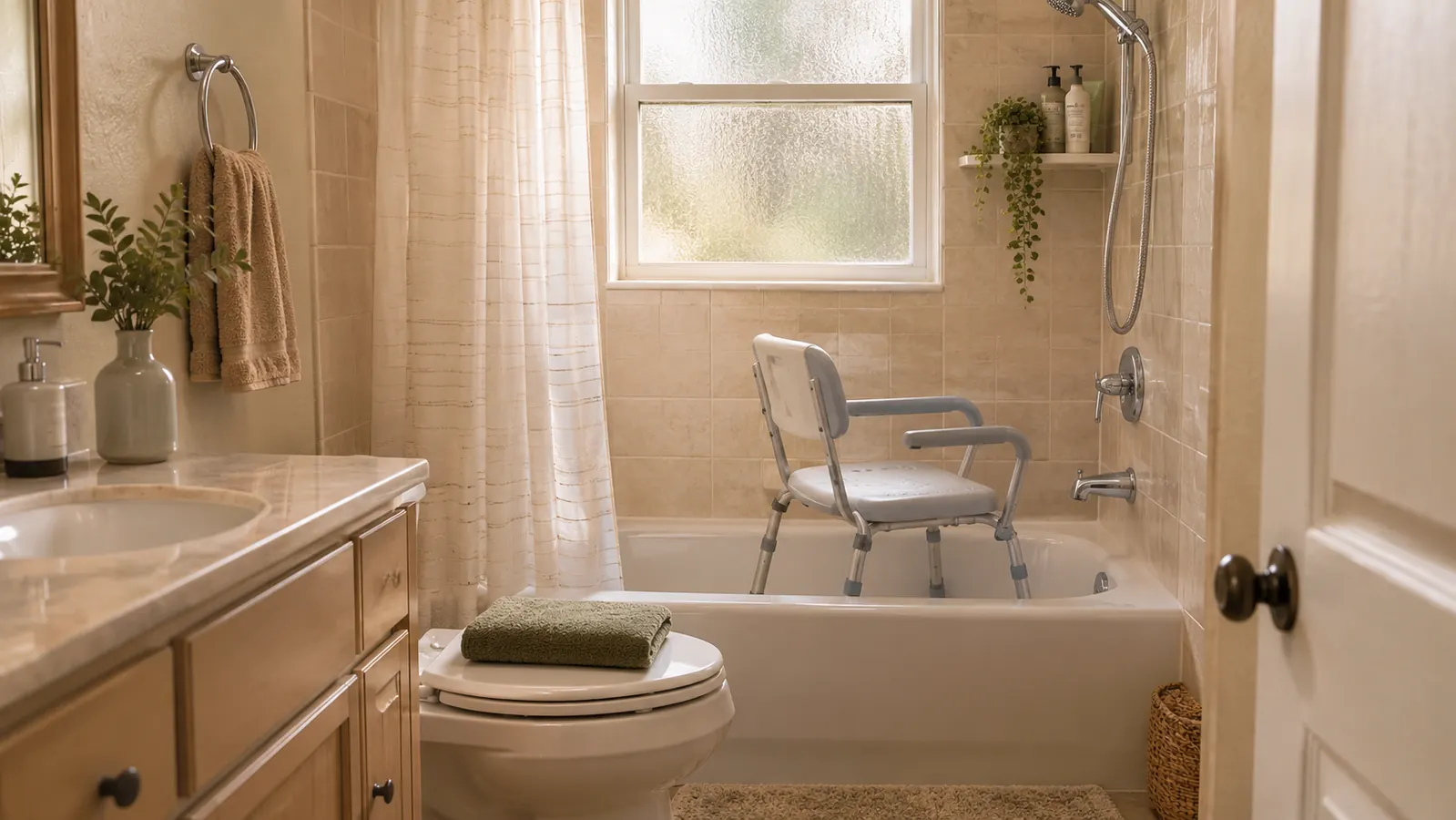
The first thing I noticed after my fall was not the bruise. It was how long I stood in the garage deciding whether to get up. My right knee had quit on the concrete and my lower back had locked, and I remember thinking that a bathtub would have been a far worse place to find that out. I am 71, a retired machinist outside Huntsville, Alabama, and I have arthritis in both knees. Joan, my wife, started leaving catalogs on the kitchen table. The one I kept coming back to was the Dr. Kay's shower chair: aluminum frame, seat 16.7 by 10.5 inches, five leg heights, rated to 350 pounds. Here is what a chair in the tub actually changes, in plain terms.
One note before the list. I am not a doctor and this is not medical advice. My physical therapist looked at my setup before I trusted it, and if your balance or your knees have changed lately, have yours look at yours too. A chair is a tool, not a treatment.
A wet tub floor is a bad place to test your balance
The Dr. Kay's shower chair sits inside the tub on five adjustable leg heights, with built-in side handles and a 350 pound rating. Aluminum frame, 2.1 kg, lifts out with one hand when you are done.
Amazon See Today's Options on Amazon →Your feet stop hunting for grip on wet porcelain
A tub floor is the slickest surface in the house once it is wet, and my balance is not what it was at 50. The chair does not change the floor. It changes how long you have to stand on it. I wash, I rinse, I get out, and the standing portion of my shower went from six or seven minutes to under two. That is a lot fewer chances to slip. People fixate on grab bars and rubber mats and skip the simplest change, which is standing less.
Five leg heights let the seat meet your knees instead of the other way around
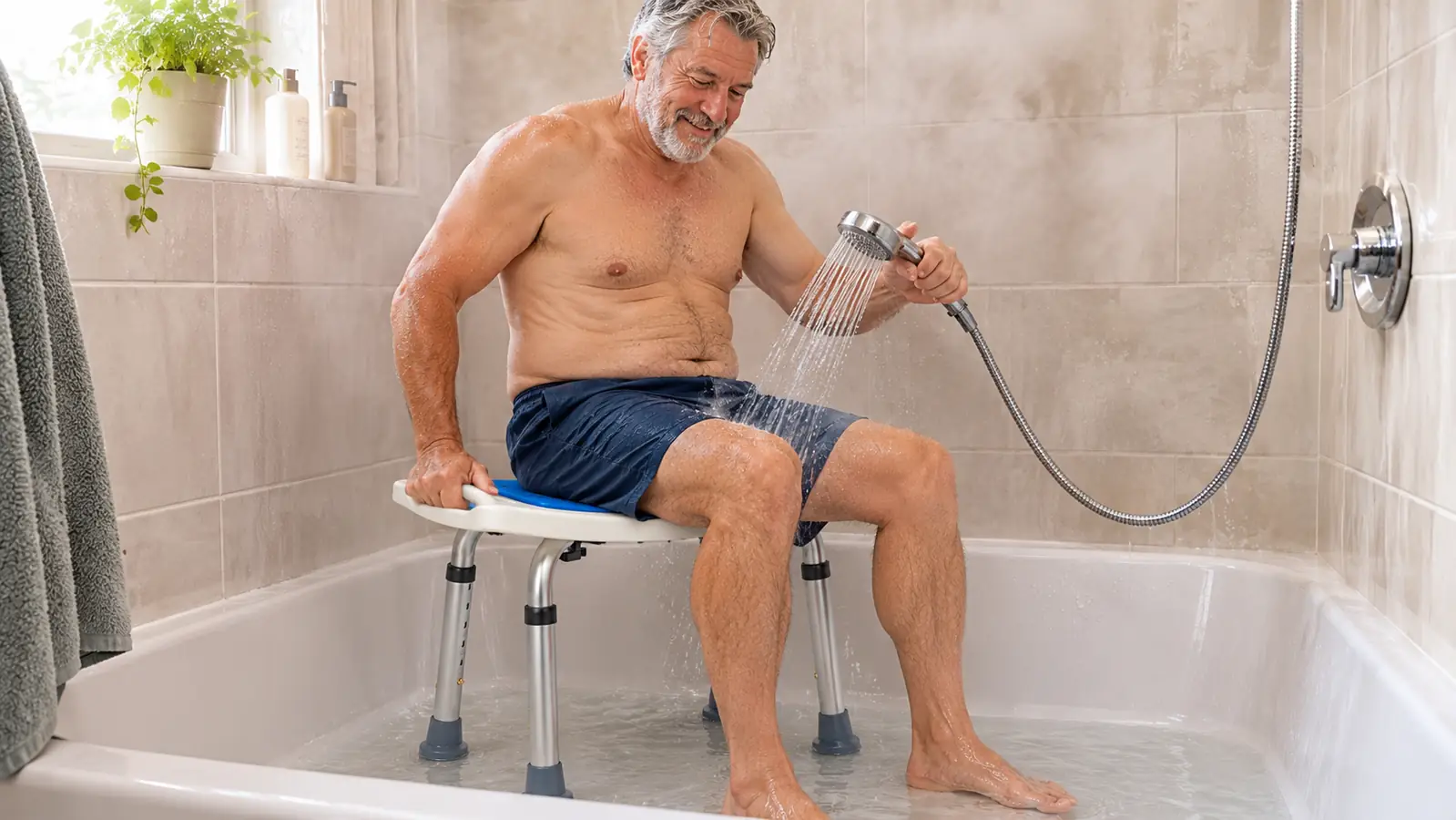
The legs adjust to 13.4, 14.4, 15.4, 17.2, and 18.5 inches. That reads like a spec sheet, but it is the difference between a chair you use and a chair that hurts. My physical therapist told me the seat should let my feet sit flat on the tub floor with my knees bent and my thighs supported, not with my legs dangling. On this Dr. Kay's chair, the second tallest setting does that for me. Before you buy anything, measure from the floor to the crease behind your knee.
The seat is wide enough to actually sit on: 16.7 by 10.5 inches
A lot of bath seats are narrow enough that you perch instead of sit, and perching is exactly what tired legs do badly. This one gives you 16.7 inches by 10.5. I can sit square on it with both feet down and wash one leg at a time without shifting my weight around. If you are a bigger person, measure that number against a kitchen chair you already sit in comfortably. It is the fastest reality check there is.
Getting in turns into two small moves instead of one big one
The step over the tub wall is the part that worries Joan. With the chair parked at the back of the tub, I hold the wall, put my good foot in, sit down, then swing the second foot over. No hopping, no leaning on a shower curtain, no grabbing at a towel bar that was never meant to hold a person. It also means I am seated before I start messing with the water, so I am not adjusting a handle while standing on one leg.
Built-in side handles give your hands a job
The handles are built into the sides of the Dr. Kay's chair, and I use them more than I expected. One hand on the handle to lower myself down, one on the sprayer. During a stretch when my back was acting up, I braced a forearm on the handle and let my legs do less. That is not the same thing as a grab bar bolted into a stud, and I want to be clear about the difference. It is a steadying point, not a fixture.
Washing your hair stops being a balance exercise
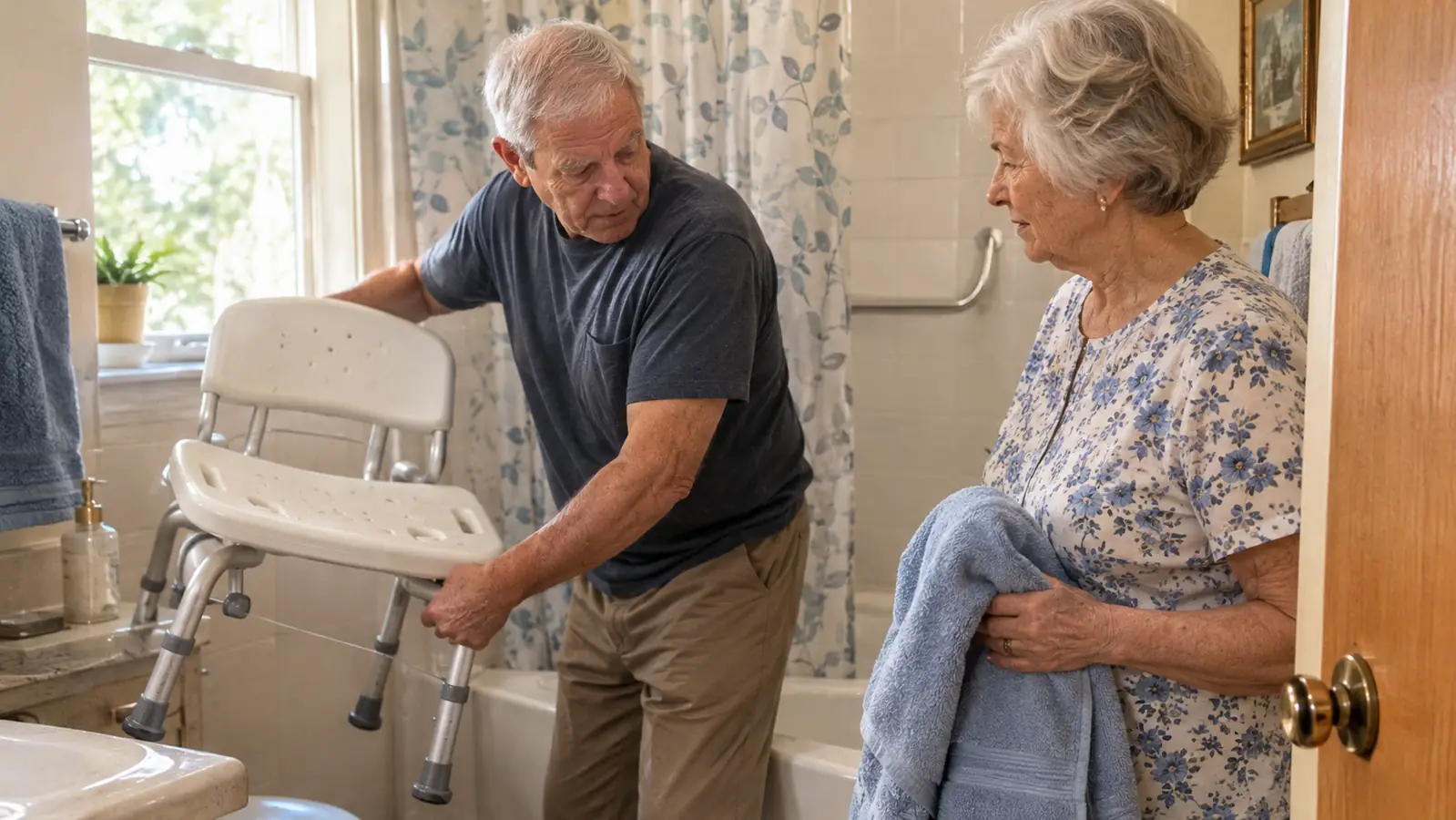
Leaning back to rinse under a showerhead is how I used to end up with my eyes shut, my head tipped back, and no idea where the wall was. Now I sit, tip my head forward, and use the handheld sprayer with one hand while the other stays on a side handle. The whole thing takes two minutes and I never lose track of which way is up. Small change, and it is the one I would fight hardest to keep.
Tired legs quit setting the schedule for the whole shower
Before the chair, I showered in a hurry because standing wore me out, and I took fewer showers for the same reason. That is a bad trade for anybody and a worse one when you are 71 and it is August in Alabama. Sitting down gives my legs a break in the middle of the job. I still get tired. I get tired later, and I finish the shower instead of cutting it short.
An aluminum frame that will not rust, at 2.1 kg
The frame is aluminum, so a wet tub does not eat it, and the whole chair weighs 2.1 kg. That is a bit under five pounds, which means I can lift it out with one hand and stand it behind the door when the grandchildren visit. A heavier chair may feel more planted, but a chair you dread moving is a chair that stays in the tub getting in everybody's way.
A 350 pound rating, so nothing flexes under you
The listing rates it to 350 pounds. I am not a small man, so there is margin, and margin is what I want in something I sit on over a hard tub floor. I have not felt the frame shift or a leg walk. Check the rating against your own weight with room to spare, and check it again if a caregiver is going to be leaning on it with you. That is not a number to cut close.
It makes it easier to let somebody help you
This is the one I did not expect to matter. When Joan has to hand me a towel or steady the sprayer, she is not holding up a grown man who is wobbling on one leg. She is handing something to a person who is already sitting down. It keeps a bad morning from turning into a discussion about who is being careful enough. Dignity is a real feature, and most listings do not bother to mention it.
What I'd Skip
I would skip the suction grab bar. It is fine for holding a towel. It is not fine for holding a person, and it will let go at the worst possible moment. I would skip a bath mat that curls at the corners, and I would skip any arrangement where the chair is your only support in the tub. If stepping over the tub wall is not something you can do at all, a shower chair is the wrong tool and a transfer bench is the right one. There is a side-by-side breakdown of those two on this site, along with a longer-term review of the same Dr. Kay's chair.
The other thing I would skip is buying before you measure. Measure the inside of your tub, measure from the tub floor to the crease behind your knee, and measure how much space the curtain needs. Most returns on this kind of gear are not about quality. They are about a chair that was the wrong height for a particular person in a particular tub.
I set the legs at 17.2 inches. My feet sit flat on the tub floor, my knees are bent, and I am not holding myself up with my arms. That one measurement is the whole job.
Measure your leg, then pick the height that matches it
The Dr. Kay's shower chair adjusts to 13.4, 14.4, 15.4, 17.2, and 18.5 inches, with a 16.7 by 10.5 inch seat and built-in side handles. Aluminum frame, 350 pound rating.
Amazon See Today's Options on Amazon →