
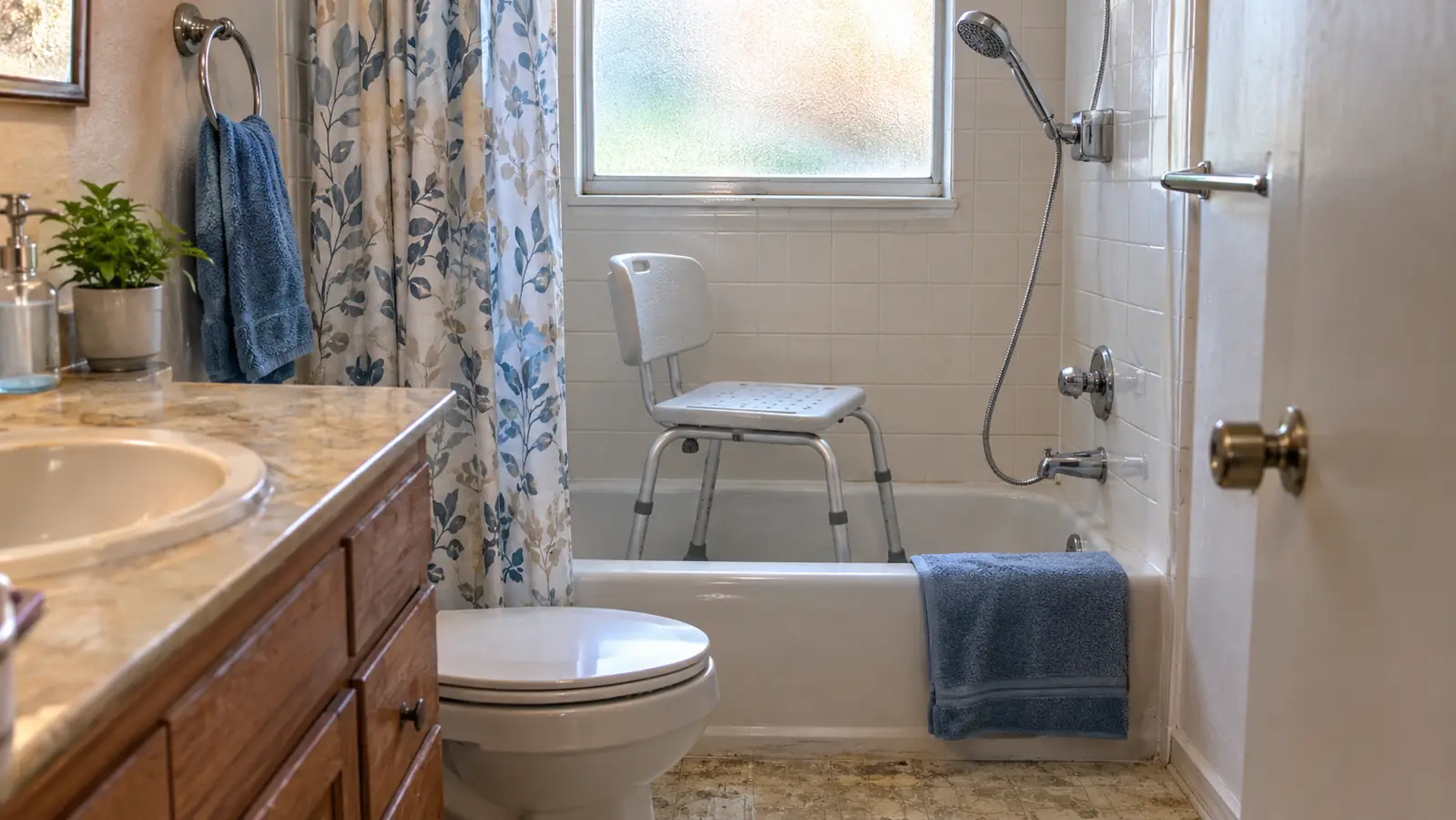
Dr. Kay's shower chair came into this house in March, three weeks after my right knee quit on me halfway out of the tub. I did not fall. I got one hand on the shower curtain rod and the other flat against the tile and stood there dripping until things settled down. Joan came in, looked at me for a second, and said she was ordering something. That is generally how decisions get made here now.
I am 71, retired out of a machine shop, and I have arthritis in both knees plus a lower back that stiffens up if I stand in one place too long. Our bathroom is one small hall bath with a tub-shower combo and maybe two feet of clear floor beside it. Nothing elaborate goes in there. So this is not a review written from a showroom. It is six months of daily use in a cramped bath outside Huntsville, and it covers what the five seat heights mean in practice, what the side handles are actually good for, and the three things about the Dr. Kay's chair that still bother me.
The Quick Verdict
Stable, light enough to lift out with one hand, and the five seat heights are real numbers instead of decoration. The seat is shallow front to back and there is a two inch gap in the middle of the height range that will leave some people stuck between settings.
Amazon Check Today's Price →Six months in my tub and it has not moved once. Here is what it costs today.
Aluminum frame at 2.1 kg, five seat heights from 13.4 to 18.5 inches, listing rated to 350 pounds. Measure your tub floor before you order so you know which setting you need.
Amazon Check Today's Price on Amazon →How I've Used It
The chair sits crosswise in the tub and I shower sitting down every morning. I settled on the 15.4 inch setting. At five foot nine and a little over two hundred pounds, that puts my knees roughly level with my hips, which is the thing my physical therapist told me to aim for when we went over the bathroom. Your number will be different from mine. Measure from the floor of the tub, not the bathroom floor. In our bath those two measurements differ by nearly two inches, and if you get that wrong you will order the wrong setting and blame the chair.
Getting in and out was the part I worried about. The chair does not shift when I sit down on it, which was my main fear and the reason I put off buying one for a year. The feet grip the tub floor and I have not had it slide once, including the morning I forgot myself and put my full weight down faster than I meant to. I do not step over the tub wall and pivot onto the seat the way some folks do. I sit on the tub rim, swing my legs over, then slide back. That is a me thing, not a chair thing, and it is worth knowing before you buy any seat like this.
The rest of the routine is simple. I keep a handheld showerhead on a hook at chest height and use the left side handle to park it between rinses. That is not what the handle is for, but it works and it beats laying the thing on the tub floor. When I am done I stand, dry off, and lift the chair out by one handle and set it against the wall so the tub can drain and Joan can take her shower. That lift is the entire reason the 2.1 kg weight matters to me. A heavier chair would have stayed in the tub and I would be cleaning around it forever.
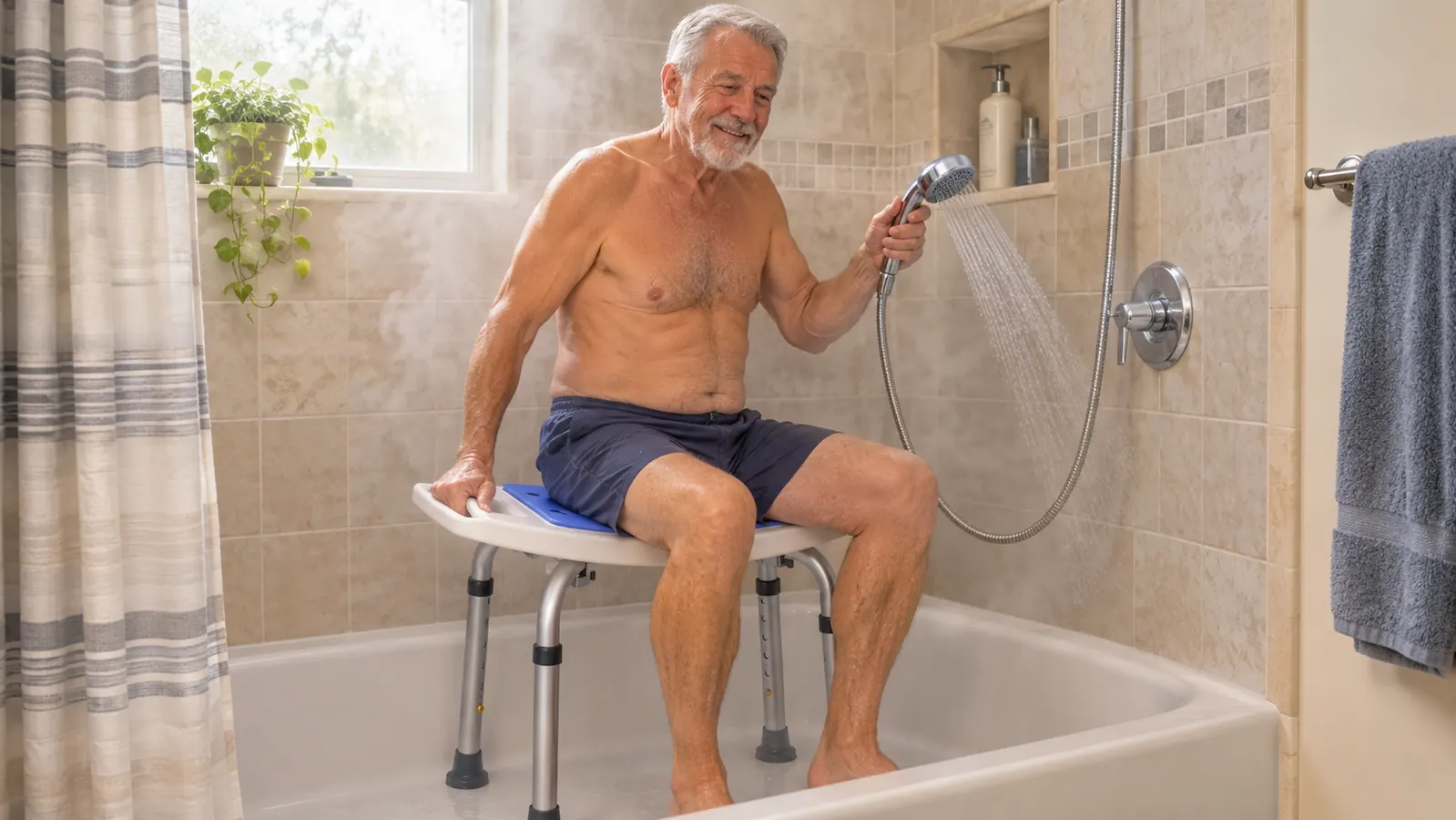
What the Five Seat Heights Actually Get You
The listing gives five settings: 13.4, 14.4, 15.4, 17.2, and 18.5 inches. Read that list twice, because there is a two inch gap between 15.4 and 17.2, and that gap is the first complaint I would raise if I were designing this thing. If your ideal seat height lands around sixteen inches, you pick a touch low or a touch high and live with it. My knee likes 15.4 and would have liked 16 better. It is a small thing. It is also the kind of small thing that decides whether a piece of equipment gets used or ends up in the garage.
The bottom of the range is genuinely low. At 13.4 inches you are sitting at about the height of a dining chair seat, and if you have had a hip replaced or your knees do not bend past ninety degrees, that is a hard sit down and a harder stand up. Keep in mind the listing also states a minimum height of 14.5 inches in its specifications. It works fine at the lower settings for me, but if you need the very bottom of the range, ask the seller to confirm before you commit.
The top of the range is 18.5 inches, close to a counter stool. That is easy to sit down on and awkward to stand up from, because your feet want to reach for the floor and the floor is not where they expect it. I tried it once for the sake of this review and went back to 15.4 the same morning. Setting it up took a few minutes and I did it on the bathroom floor rather than in the tub, because I wanted to check level before committing. Whatever height you pick, all four legs need to match. I marked mine with a strip of tape so I would not lose the setting, and in six months I have not had to change it once.
The Side Handles Are the Part I Did Not Expect to Use
The built-in side handles are on both sides of the seat and they are the reason I would buy this chair again over a plainer one. I use the right handle every single morning to push off when I stand. It gives me something solid at hip height, which is exactly where I need it, and it does not flex or give when I lean on it. My physical therapist watched me do it once and did not have a complaint, which from her is high praise.
Here is the part I want to be straight about. These handles are not grab bars. They are attached to a chair that sits on the tub floor and they are meant to steady you, not to take your whole body weight while you haul yourself up out of a seated position. If you need real support getting in and out of the tub, that is a wall-anchored grab bar installed into studs, and it is a separate job. I have both. The chair handles help me. The grab bar is what I would want if the knee went out completely. Talk to your doctor or a physical therapist about what you actually need, because that answer depends on you and not on a product listing.
The Seat Itself: 16.7 Inches by 10.5 Inches
The seat surface measures 16.7 inches across and 10.5 inches front to back. The width is fine. The depth is where this chair shows its hand. Ten and a half inches is shallow, and if you are tall or long in the leg, you will feel the front edge of that seat end earlier than you would like. I notice it most on the mornings my back is stiff and I want to lean forward and let the water hit it. You sit square on this chair. It is a seat, not a lounge chair, and it is not trying to be.
For a ten minute shower, the depth has never once been a problem. For a long soak or a shower where you want to sit back and rest, it would get old. That is the honest tradeoff, and it is the tradeoff that keeps this chair narrow enough to fit in a tub this small. A deeper seat would have been more comfortable and would not have left me any room to swing my legs over the tub wall. Everything in a bathroom this size is a negotiation.
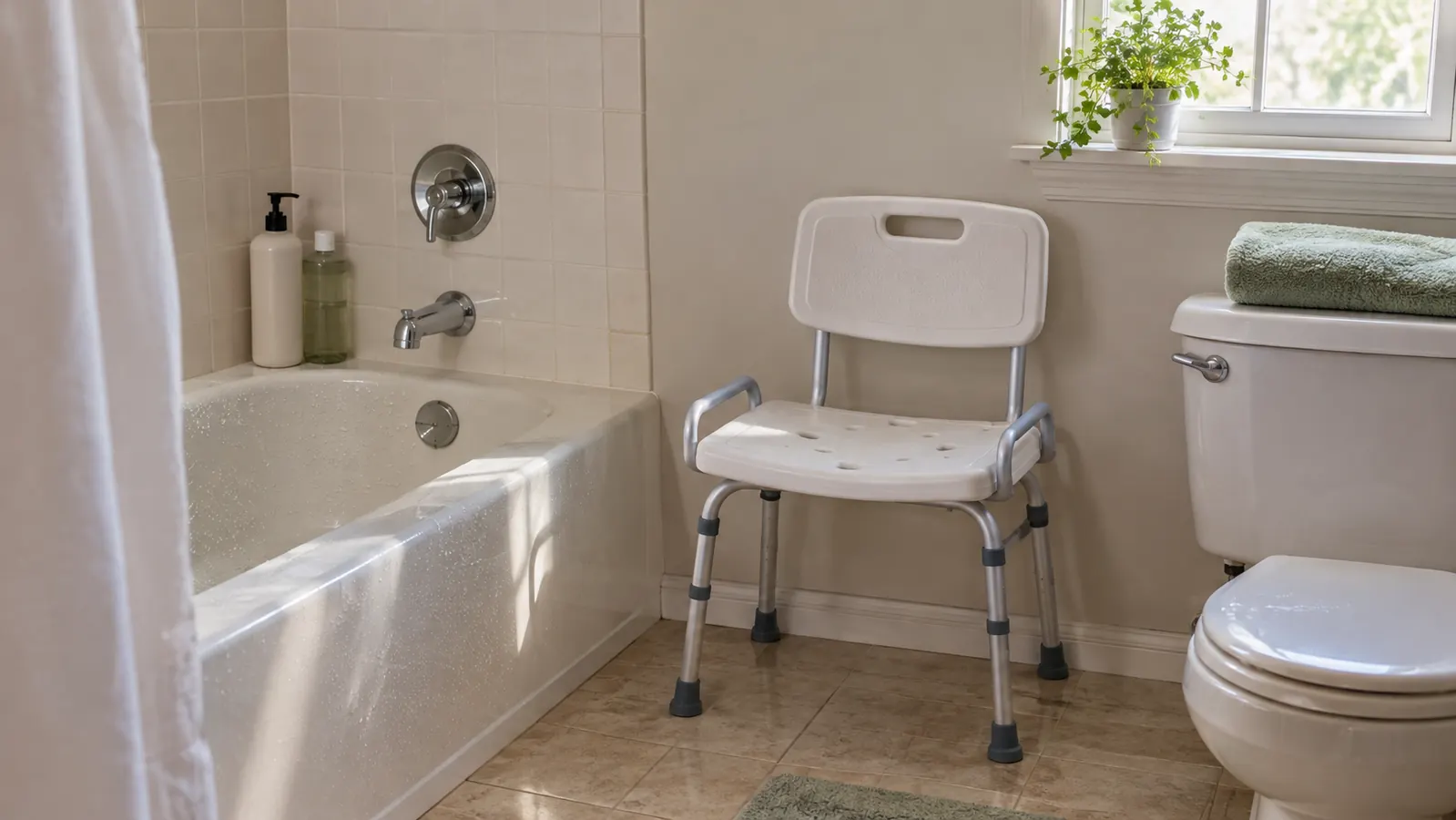
Aluminum, Weight, and Six Months of Wet Feet
The frame is aluminum with a bright reflective finish. It has lived wet for six months, sitting in a tub that gets used twice a day, and there is no rust on it anywhere. Aluminum does not rust the way steel does, which is the whole reason it is the right material for a wet room. What I watch for instead is the joints and the feet. I wipe the chair down about once a week with a rag and give the feet a look, and so far nothing has cracked, softened, or started to wobble.
The one thing you should know before you order is that the listing contradicts itself on capacity. The title says 300 pounds of support. The specifications list a maximum weight recommendation of 350 pounds. I am a little over two hundred, so it does not affect me, and I cannot tell you which number is the real one. What I can tell you is that if you are anywhere close to either figure, contact the seller and get it in writing before you buy. A chair is not the place to guess at a rating.
At 2.1 kg it is light. I lift it out of the tub with one hand every morning and set it against the wall, and I have carried it out to the porch to hose it off twice. Light is not a luxury here. A chair you cannot lift is a chair you leave in the tub, and a chair you leave in the tub is one more thing to step around in a room with no floor space to spare.
Where It Falls Short
The height gap is the first thing. Fifteen point four to seventeen point two is a two inch hole, and if your body wants sixteen you will notice it every morning. The second thing is the seat depth, 10.5 inches, which is fine for me and would be tight for a taller man or woman.
The third thing is bigger, and it is not really a defect in the chair. This is a seat that sits inside the tub. It does nothing whatsoever about the tub wall itself. Getting your legs over that wall is still on you, and if that is the hard part for you, a chair is not your answer. I have read enough about transfer benches to know that is a different piece of equipment with a different set of problems, and if you cannot clear the tub wall safely, that is where you should be looking instead.
Finally, understand what you are buying. This is a well made aluminum seat with handles, a wide footprint, and honest height settings. It is not a medical device, it is not a grab bar, and it will not fix a knee. It removes one specific hazard from my morning, which is standing on a slick tub floor with my eyes closed while rinsing shampoo. That is worth what it cost. It is not worth more than that, and nobody should sell it to you as more than that.
What I Liked
- Four feet grip the tub floor and it has not shifted once in six months of daily use.
- At 2.1 kg I lift it out of the tub with one hand to let the tub drain.
- Five real height settings from 13.4 to 18.5 inches, so most people will find a workable number.
- Built-in side handles on both sides give you a solid place to push off when you stand.
- Aluminum frame with a reflective finish and no rust showing after six months of daily wet use.
Where It Falls Short
- The jump from 15.4 to 17.2 inches leaves a two inch gap that some people will land right in the middle of.
- Seat depth is only 10.5 inches, which is shallow for anyone tall or long legged.
- The listing contradicts itself on capacity, 350 pounds in the specifications and 300 in the title.
- It does nothing about the tub wall. If stepping over the wall is your problem, this is the wrong product.
- The product description and the specifications disagree on the minimum height as well.
The chair has not moved under me once in six months. When you are standing in a wet tub with a bad knee, that is the only review that counts for anything.
Who This Is For
This chair is for someone who can still get over the tub wall on their own but should not be standing up in the tub. That was exactly my situation. The knee buckles after I have been sitting a while, and standing on a slick surface with my eyes shut was asking for a fall. If that describes you, the Dr. Kay's chair solves the problem cleanly and gets out of the way when someone else needs the shower. It also suits a small bathroom, which is most bathrooms. It fits in ours with room to swing my legs over, and I did not have to move anything to make that happen.
Who Should Skip It
Skip it if the tub wall is the obstacle. A chair inside the tub assumes you can get your legs over that wall and onto the seat edge on your own. If you cannot do that, you want a transfer bench that straddles the wall, or you want to talk to your physical therapist about what the bathroom should actually look like. Skip it too if you are near the weight rating, until you have the real number in writing from the seller. And skip it if you want a deep, comfortable seat to sit back in. This is sixteen point seven inches by ten point five, and it is built to be small on purpose.
If you can still clear the tub wall, this is the cheapest piece of mind in the house.
Five seat heights, side handles on both sides, 2.1 kg, aluminum frame. Confirm today's price and the height setting you need before you order.
Amazon Check Today's Price on Amazon →