

I have arthritis in both knees and a right knee that buckles if I sit too long. My one bathroom is a small hall bath with a tub-shower combo, and the tub wall is the part I have to think about every morning. The Dr. Kay's Shower Chair is the one I keep inside that tub. It is an aluminum chair with a 16.7 by 10.5 inch seat, built-in side handles, and five height settings listed at 13.4, 14.4, 15.4, 17.2 and 18.5 inches. It is not a transfer bench. That difference is the whole comparison. One is a seat you step into. The other is a bench you sit on before you cross the tub wall.
Here is the short answer. If you can stand at the tub wall, hold something solid, and step over into the tub, the Dr. Kay's Shower Chair is the simpler choice. It takes up little room, lifts out when you need the tub for someone else, and gives you a seat and two side handles once you are inside. If stepping over that wall is the part that makes you hesitate, a transfer bench is the better tool. A transfer bench lets you sit down outside the tub first, then slide across. The Dr. Kay's chair cannot do that. No shower chair that sits inside the tub can. The choice is not about which product is better in general. It is about which motion you can make safely.
| Dr. Kay's Shower Chair | Standard Transfer Bench | |
|---|---|---|
| What it does | Sits inside the tub or shower. You step in, then sit. | Straddles the tub wall. You sit outside, then slide across. |
| Getting past the tub wall | You still step over the wall before you sit. | You sit first, then slide over the wall. |
| Footprint in a small bath | One compact chair inside the tub; lifts out when not in use. | Long bench extends onto the bathroom floor and takes up space. |
| Seat and hand support | 16.7 by 10.5 inch seat with built-in side handles. No backrest is listed. | Many models add a backrest and a longer seat; check the model. |
| Height settings | Listed at 13.4, 14.4, 15.4, 17.2 and 18.5 inches. | Most are height adjustable, but the range varies by brand. |
| Storage | Aluminum frame, 2.1 kg. Easy to lift out and set aside. | Longer and heavier. Harder to store in a small hall bath. |
| Weight rating | Title says 300 pound support; attribute table says 350 pound maximum. Ask the seller which number governs. | Varies by model. Read the label on the one you buy. |
| Best for | A bather who can step over the tub wall but needs a stable seat and side handles. | A bather who cannot safely step over the tub wall. |
Where Dr. Kay's Shower Chair Wins
The Dr. Kay's Shower Chair wins on fit in a small bathroom. My hall bath is not big enough for a long bench outside the tub. The Dr. Kay's chair stays inside the tub, so the floor stays clear. At 2.1 kg, I can lift it out with one hand when Joan wants to clean the tub. The seat is 16.7 by 10.5 inches, which is wide enough to sit on without perching on the edge. A transfer bench may have a longer seat, but it also has a longer frame. In a tight room, that frame is the difference between a tool you use and a tool you move out of the way every time.
It also wins on the small details I actually touch. The built-in side handles give me something to hold when I stand up, and the listing notes they can help with a handheld showerhead. The five height settings are marked at 13.4, 14.4, 15.4, 17.2 and 18.5 inches. I set mine where my feet sit flat on the tub floor. The aluminum frame is light, and the reflective surface is easy to wipe down. I do not need a backrest to wash my hair. I need side handles where my hands land and a seat height that lets me keep both feet flat. The Dr. Kay's chair does that part well.

Where a Transfer Bench Wins
A transfer bench wins the tub wall. If your knee buckles when you lift it over the tub edge, sitting first is the whole point. You sit on the outside half of the bench, then slide across to the inside half. That is a different motion than standing and stepping. For some people, that is the difference between bathing at home and not bathing at home. The Dr. Kay's Shower Chair asks you to do the hard part first. A transfer bench lets you do the hard part while already seated. That is not a small thing if your balance is not what it used to be.
It also wins if you need to keep both legs moving without a high step. But it gives up floor space. In my hall bath, the door would not clear a long bench without moving it. A transfer bench often has a backrest and a longer seat, and that can be easier on the back. Models vary a lot in width and leg spread, so check the measurements before you buy. If your bathroom is tight, the bench may be the right tool in the wrong room. That is not a knock on the bench. It is a measurement problem.
What Neither One Fixes
Neither one fixes a slick tub floor, a loose grab bar, or a bathroom door that swings into the space where you need to stand. The Dr. Kay's chair gives you a seat and side handles. It does not turn a tub into a walk-in shower. A transfer bench gives you a way to sit before you slide. It does not make the tub wall disappear. If you need a walk-in shower, save for a walk-in shower. Do not buy a bench and pretend it is one. That is how people end up with a bathroom full of equipment that does not solve the problem.
Neither one replaces a grab bar at the tub wall. The side handles on the Dr. Kay's chair are for your hands once you are seated or standing at the chair. They are not a handhold for the step over the wall. If you need a bar at the wall, put a bar at the wall. A suction bar is not the same as a bar screwed into a stud. Ask someone who knows your bathroom before you drill. I am not a contractor, and I am not a doctor. I am a retired machinist who has learned to check the mounting before he trusts the handle.
Neither one is a substitute for a physical therapist watching you move. I can tell you what worked in my hall bath. I cannot see your knees, your tub, or your floor. A therapist can watch you get in and out and tell you what to change. That is worth more than any list of specs. The Dr. Kay's chair is a tool. A transfer bench is a different tool. The person using the tool is the one who has to be safe. Buy the tool that fits the person, not the tool that fits the product page.
If You Can Step Over the Tub Wall, This Is the Seat I Would Put Inside It
The Dr. Kay's Shower Chair gives you a 16.7 by 10.5 inch seat, built-in side handles, and five listed height settings in a 2.1 kg aluminum frame. It fits inside a tub-shower combo and lifts out when you need the tub.
Amazon See the Dr. Kay's Shower Chair on Amazon →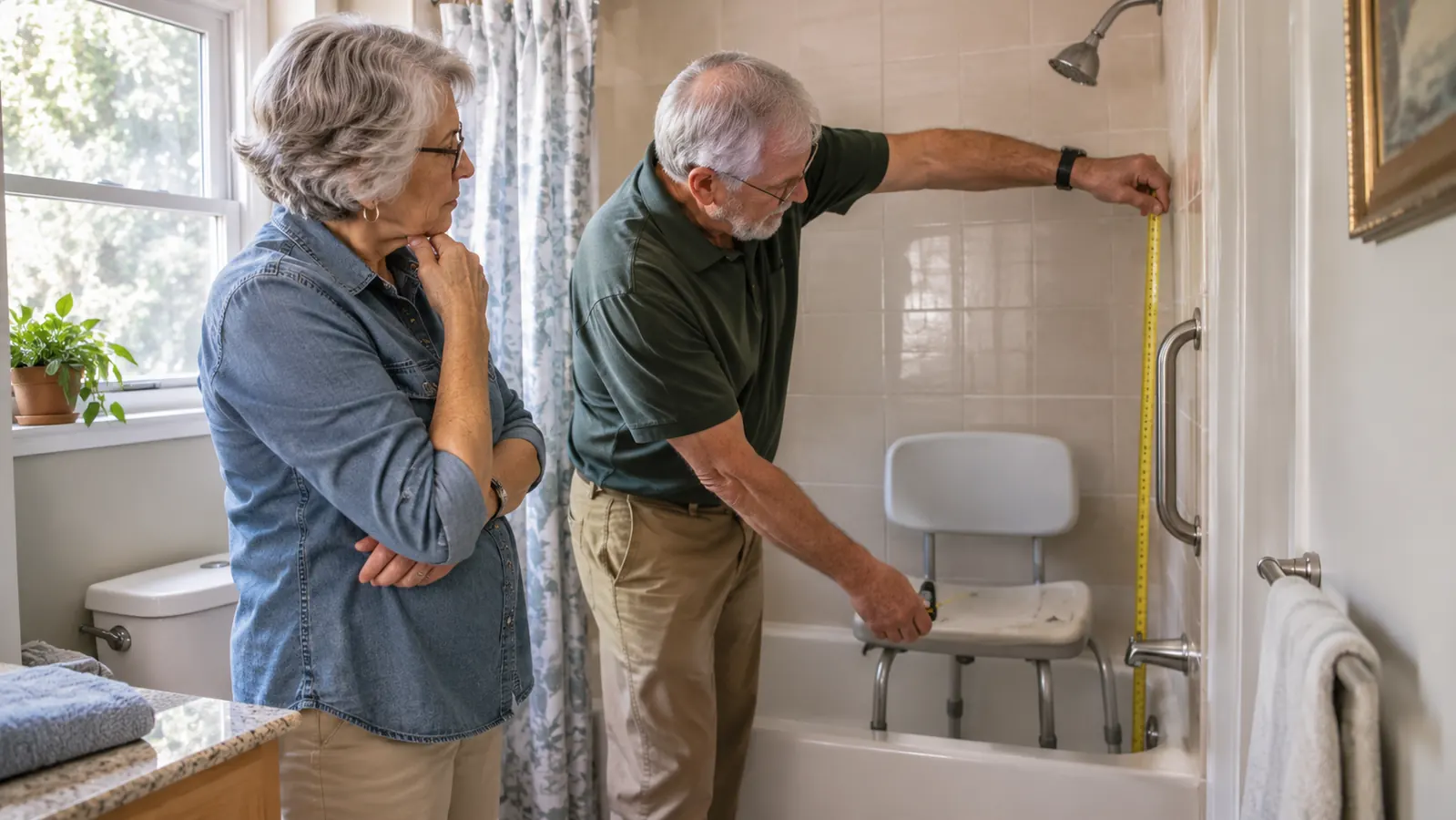
The Details That Matter in a Small Hall Bath
Measure the tub wall and the floor space outside it before you choose. The Dr. Kay's chair sits inside the tub, so the floor stays clear. A transfer bench needs room outside the tub for the seat and for your feet. In my bathroom, that space is where the door swings. A bench that fits the tub but blocks the door is not a bench you will keep. Put a tape measure on the floor, open the door, and see what is left. Then measure the tub wall height from the bathroom floor. That number tells you whether a shower chair is even in the conversation.
Seat height is the next thing. The Dr. Kay's chair lists settings at 13.4, 14.4, 15.4, 17.2 and 18.5 inches. Sit on a kitchen chair and measure from the floor to the top of the seat. That gives you a starting point. Then check the tub floor. You want your feet flat and your knees not higher than your hips when you sit. I am not going to tell you what height to use. My physical therapist watched me get in and out and told me what to check. Ask yours to do the same. A number on a listing is not a fitting.
The weight rating is muddy, and you should know that before you buy. The Dr. Kay's title says 300 pound support. The attribute table on the listing says 350 pound maximum. I would go by the lower number if I were near that line. Ask the seller which number governs the frame and the seat. Do not guess. The chair is rated for a person, not for a pile of laundry, and the number matters if you use it every day. The rest of the specs are simple: aluminum frame, 2.1 kg, 16.7 by 10.5 inch seat, built-in side handles.
The seat is 16.7 by 10.5 inches and the frame is 2.1 kg. That is small enough to lift out with one hand and wide enough to sit on without perching.
How I Would Choose
Try the motion, not the label. Stand at your tub. Hold the wall or a grab bar. Lift one foot over the tub wall. If that feels steady, a shower chair is enough. If you have to think about it, a transfer bench is the safer buy. Do not choose based on the name on the box. Choose based on the motion you have to make every morning. The Dr. Kay's chair is a good chair, but it cannot make a high tub wall lower. No chair can. The transfer bench is not a better chair. It is a different answer to a different problem.
If you go with the Dr. Kay's chair, set it up with a dry run before you add water. Put it in the tub, set the height, and sit down with clothes on. Stand up using the side handles. Reach for the shampoo and the handheld showerhead. See where your feet land. If the seat feels too low or too high, change it before you get wet. The five settings are there for a reason. The chair is light enough to lift out, so you can test it without making a project of it. A dry run costs you five minutes. A bad first try in a wet tub costs more.
One more thing: check the return policy and the box before you assemble anything. If the chair is too tall or the bench is too long, you want to know that before you throw away the packaging. I have made that mistake with a different purchase, and it cost me a Saturday. The Dr. Kay's chair is light enough to lift out, but it still has to fit your tub. Measure first, then buy. Keep the packaging until you have used it once. That is not glamorous advice, but it is the advice I follow.
Who Should Buy Which
Buy the Dr. Kay's Shower Chair if you can step over the tub wall with a hand on something solid, you want to keep the bathroom floor clear, and you need a compact seat with side handles. Buy a transfer bench if you cannot step over the wall, if you need to sit before your legs move, or if a helper has to lift your legs over the edge. If you are between the two, ask your physical therapist to watch you get in and out of the tub. That beats any online comparison, including mine. The right choice is the one you can use without a second thought when you are tired.
For the Bather Who Can Still Step In, but Should Not Stand
The Dr. Kay's Shower Chair is the compact inside-the-tub option: a 16.7 by 10.5 inch seat, built-in side handles, five height settings, and a 2.1 kg aluminum frame. Check the weight rating with the seller if you are near 300 pounds.
Amazon See the Dr. Kay's Shower Chair on Amazon →