

The fall happened in my own garage, maybe four feet from a stool I had owned for thirty years. My right knee folded without warning, the way it had been threatening to for months, and I went down hard enough to bruise a hip and my pride in the same motion. I am 71, a retired machinist, and up until that afternoon I had been telling myself that a bad knee was a thing a man simply works around.
Joan, my wife, is the one who called the doctor. The doctor sent me to a physical therapist, and the physical therapist is the one who stood at the end of a hallway, watched me walk, and told me my stride had gotten short and careful. Then she told me the carefulness was feeding the problem instead of protecting the knee. Her suggestion was a four wheel walker with a seat and a back support. I bought the Drive Medical Rollator Walker with Seat, the model with 7.5 inch wheels and a fold up removable back, and I have used it near every day since. What follows is the plain accounting of how that has gone.
The Quick Verdict
A 20 pound alloy steel frame rated to 350 pounds, with a seat I trust and a back that lifts off. Superb on plank, tile and sidewalk. Weak on gravel and lawn.
Amazon Check Today's Price →The Walker I Actually Use Every Day, Not the One I Thought I Wanted
Four wheels, a seat, and a back support that lifts off so the frame folds flat into a trunk. Check the size chart and today's price before you order.
Amazon Check Today's Price on Amazon →How I've Used It
Months now, not weeks. Mine lives beside the front door because that is where I need it, and it goes out onto the porch, down the two concrete steps, and along the walk to the mailbox. From there it comes back in and rolls to the kitchen, where the vinyl plank is the easiest floor in this house for it.
On the carpet in the bedrooms it takes a firmer push, which is true of every four wheel walker I have tried and not a knock on this one. In the hall bathroom, where we have a tub and shower combination and just about enough floor to turn around if you plan the move, the 21.5 inch width is tight. I back out of that room instead of trying a three point turn, and after a month that stopped feeling like a workaround and started feeling like the normal way to leave a bathroom.
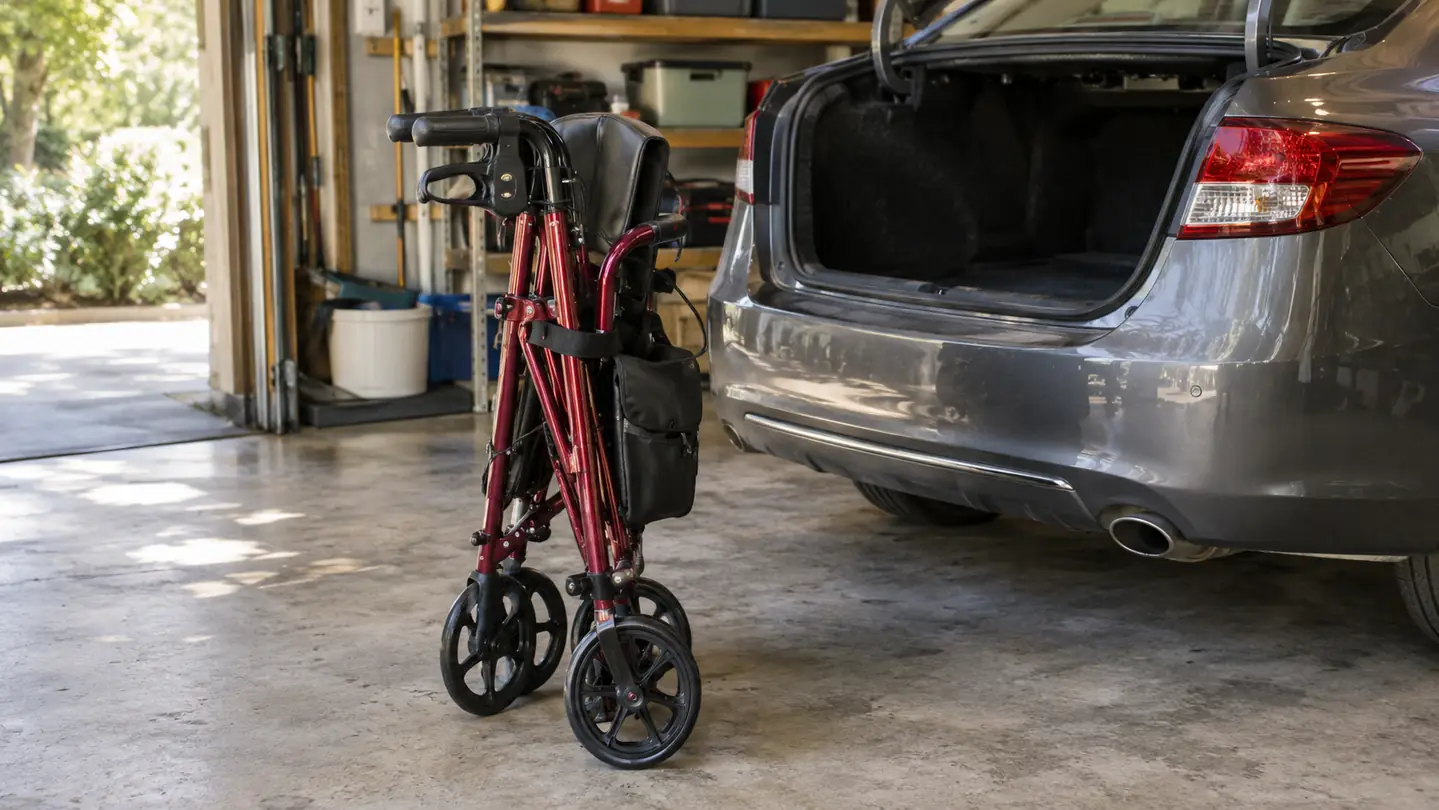
Out of the house it goes to the mailbox, to church, to the clinic, and to the hardware store where I still go on Saturdays to look at drill bits I do not need. It folds and slides into the trunk of our mid size sedan. I lift it with two hands, one on the frame and one under the seat, and I have gotten it down to about fifteen seconds. The first month it took longer and I said a few words I will not repeat in front of my daughter.
What changed most is not the walking. It is the calculating. Before the walker, every trip across a room was a small negotiation with the floor, and I was doing the math without knowing I was doing it. Now I get to the mailbox without doing the math, and that is worth more than the seat and the wheels put together.

The Frame, the Weight, and the Trunk of a Sedan
The frame is alloy steel and the whole walker weighs 20 pounds. It is rated for a maximum weight capacity of 350 pounds. I am 208 pounds, so there is a wide margin there, and margin is what keeps a frame from going loose and wobbly after a year of a grown man leaning on it. My physical therapist made the point that a walker rated well above your own weight is not overkill. It is the difference between a tool that lasts and one that develops a shimmy you cannot find.
Twenty pounds is the number people underestimate. It is light enough to push around all day. It is not light enough to lift with one hand while you are balanced on the other leg in a garage. If you have a bad back along with the bad knees, plan on two hands, or plan on somebody else putting it in the car for you. That is not a flaw in this walker. It is a fact about every walker in this class, and it is worth knowing before you buy one.
The two concrete steps at the front porch are the one place it does not help. You do not roll a walker down steps. I set it at the top, use the handrail, and Joan brings it down for me, or I carry it down one handed on the mornings I feel steady. If steps are a big part of your day, think that through before you buy any four wheel walker, mine or anybody else's.
The listing gives the dimensions as 25.5 inches deep by 21.5 inches wide by 34 inches high, with a maximum height of 35 inches. Set up in the kitchen it takes about as much floor as a chair with the seat pushed out. It carries a limited lifetime warranty from Drive Medical. I have not had to use it, and I would like to keep it that way.
The 7.5 Inch Wheels: Where They Help and Where They Don't
Seven and a half inches is the wheel, and wheel size is most of the story on any surface that is not a floor. On the plank in the kitchen, the concrete walk, the tile at the clinic and the sidewalk down our street, these roll clean and quiet and I do not think about them at all. That is the highest compliment I can pay a wheel.
On gravel, thick grass, and the packed dirt shoulder at the end of our road, they bog down. Not fail. Bog. The walker stops, and I have to lift the front end to get it rolling again, and lifting the front end of a walker while you are leaning on it is the exact motion that put a bruise on my hip the second week I owned it.
So I plan routes now. If you live on a paved street, or you are mostly indoors and on sidewalks, that is a non issue and you can skip the rest of this section. If you are picturing yourself crossing a lawn to a garden every morning, get something with bigger wheels and accept that you will pay for it in weight and in trunk space.
After months of daily use the wheels still run true and I have not had to do a thing to them. I wipe the frame down when it gets rained on and I open and close the fold a couple of times a month to keep an eye out for slop, the way I used to check a machine at the shop. Nothing has worked loose yet.
Twenty pounds is light enough to push all day. It is not light enough to lift with one hand while you are balanced on the other leg in a garage.
The Seat and the Back Support
The seat is the reason I picked this over a plain rolling walker, and the reason I have kept using it past the point where the knee calmed down. On a poor day I walk to the mailbox and sit for a few minutes on the way back. At the clinic I sit on it in the waiting room instead of in one of their chairs, which sit too low for me to get up out of without a hand from somebody.
The back support folds up and it lifts off entirely. Off is how I keep it when the walker is going in the trunk, because the frame folds flatter without it and slides in without a fight. On is how I keep it when I will be out walking for a while, because after twenty minutes my lower back wants something to lean against and I am not too proud to say so.
One honest note, and this is the one I would give a friend at the kitchen table. The seat is a perch, not a recliner. Five or ten minutes is what it is for. If you are picturing an afternoon of sitting, this is not that, and no rollator seat is. Drive Medical built this as a walking aid that happens to have a place to rest, and it works best when you use it that way. Sitting down takes a system, too. I back up until I feel the seat behind my legs, reach back with one hand, and lower myself slow. I do not flop. I learned that in the first week and I am glad I did.
What I Liked
- 20 pound alloy steel frame rated to a 350 pound maximum weight capacity, so it stays solid under a heavy lean
- Seat plus a fold up, removable back support let you rest in the middle of a trip
- 7.5 inch wheels roll clean and quiet on plank, tile, concrete and sidewalk
- Height adjustment lever with a 35 inch maximum handle height
- Folds flat enough for the trunk of a mid size sedan
- Limited lifetime warranty from Drive Medical
Where It Falls Short
- Small wheels bog down in gravel, thick grass and soft dirt
- At 20 pounds it is a two handed lift into a car trunk
- 21.5 inches wide is a tight fit in a small hall bathroom
- The seat is a short rest, not a place to spend an afternoon
- It is a walking aid, not a wheelchair, and it will not replace one
Height, Fit, and the Number That Actually Matters
The listing says the minimum height recommendation is 59 inches and the maximum handle height is 35 inches. Those two numbers are the ones to check before you order anything with handles, and I wish I had known that before I bought my first walking aid, which I used for three weeks and then gave to a neighbor.
There is a height adjustment lever and the handles come up and down with it. My physical therapist set mine with me standing straight, arms at my sides, and the handle hitting right at the crease of my wrist. The whole adjustment took about a minute. If the handles sit too low you will hunch, and if they sit too high you will shrug, and either one will make a bad back worse over a month of daily use.
I marked my setting with a piece of tape on the leg so I could find it again after Joan borrowed the walker for a church rummage sale and brought it back two notches down. I am not making that up. If you are the least bit handy, a wrap of tape or a paint pen mark costs you nothing and saves you a week of walking wrong.
Who This Is For
This is for the person with arthritic knees, a stiff back, or a knee that gives out now and then, who is still walking and wants to keep walking, and who spends most of the day on floors, sidewalks and pavement. It suits someone at least 59 inches tall. It is rated up to 350 pounds, so a heavy man or woman does not have to hunt for a special model just to get a solid frame.
It is also for the adult child doing the shopping. If you are buying for a parent, the two things to measure before you order are the height of the person and the width of the narrowest doorway in their house. Bring a tape measure. Ask about the bathroom, because that is where the floor gets tight and where most of these decisions are actually made. That one question will tell you more than any review, including this one.
Who Should Skip It
Skip it if your walking is mostly on gravel, lawn, or soft dirt. The 7.5 inch wheels are the wrong tool for that ground, and you will end up fighting the walker instead of the other way around.
Skip it if you need to lift the walker in and out of a vehicle several times a day and you have one good arm or a poor grip. Twenty pounds is a two handed lift. There are lighter frames out there if that is your situation, though you will give up some of the solidity that makes this one feel steady under a lean.
And skip it if what you actually need is a wheelchair or a transport chair. A rollator is for a person who can walk and wants support and a place to rest along the way. If standing and stepping has stopped being safe for you, this is the wrong category of equipment entirely, and that is a conversation for your doctor and your physical therapist, not for a review from a retired machinist.
Measure Twice, Then Get the One With the Seat
Clear the 59 inch minimum height. Clear 21.5 inches at your narrowest doorway. Then order it and set the handles with somebody watching you stand up straight.
Amazon Check Today's Price on Amazon →