

I have arthritis in both knees and a right knee that buckles if I sit too long. After a fall in my garage, my physical therapist told me to stop using a dining chair as a walker and get a real rollator. I tried the Drive Medical Rollator Walker with Seat for about three months. I also borrowed a Medline rollator from a neighbor for two weeks. Short answer: the Drive Medical is the sturdier choice for daily use around the house and on sidewalks, but the Medline is easier to lift into a sedan trunk. Neither one replaces a proper fitting from your physical therapist.
I am 71, a retired machinist, and I live in a one-story brick ranch outside Huntsville with my wife, Joan. My test route was not fancy: kitchen to hall bathroom, bedroom carpet, front porch steps, sidewalk to the mailbox, and the trunk of a mid-size sedan. I walked both rollators over the same route. I am not a doctor and I am not giving medical advice. I am telling you what I noticed with my own hands and knees.
How I Tested Both
The fall in my garage was the kind of thing that gets your attention without breaking a bone. I caught my toe on a floor mat and went down hard on my hip. Joan heard the noise and came running. After that, my family doctor sent me to a physical therapist who watched me walk and checked the height of my kitchen counter and the path to the bathroom. The therapist did not sell me anything. That is why I trust the fitting more than any label on a box.
The Medline came from a neighbor who used it after knee surgery and then parked it in his garage. I do not know the exact model year, and I did not have the manual. That matters. When I compare the two, I am comparing the Drive Medical I bought against the specific Medline I borrowed, not every Medline ever made. If you are shopping, write down the model number of the Medline you are considering and check its paperwork. The same rule applies to the Drive Medical: confirm the model number on the listing.
My test was simple. I walked the same route in the morning and again after sitting for an hour, when my knee is stiffest. I paid attention to three things: whether the frame felt planted when I leaned on it, whether the wheels caught on thresholds, and whether I could get it into the trunk without help. I also used the seat in the kitchen while I waited for coffee to finish. I did not test either rollator on stairs. I do not use a rollator on stairs.
I measured the hall closet because that is where the rollator lives when it is not in use. I have 22 inches of depth. The Drive Medical fit with the back folded. I also measured the trunk opening of the sedan. The Medline was easier to swing in because it was lighter. Those two measurements told me more than the pictures on the box. If you are buying for a parent, measure their closet and their car before you order.
The Specs That Actually Matter
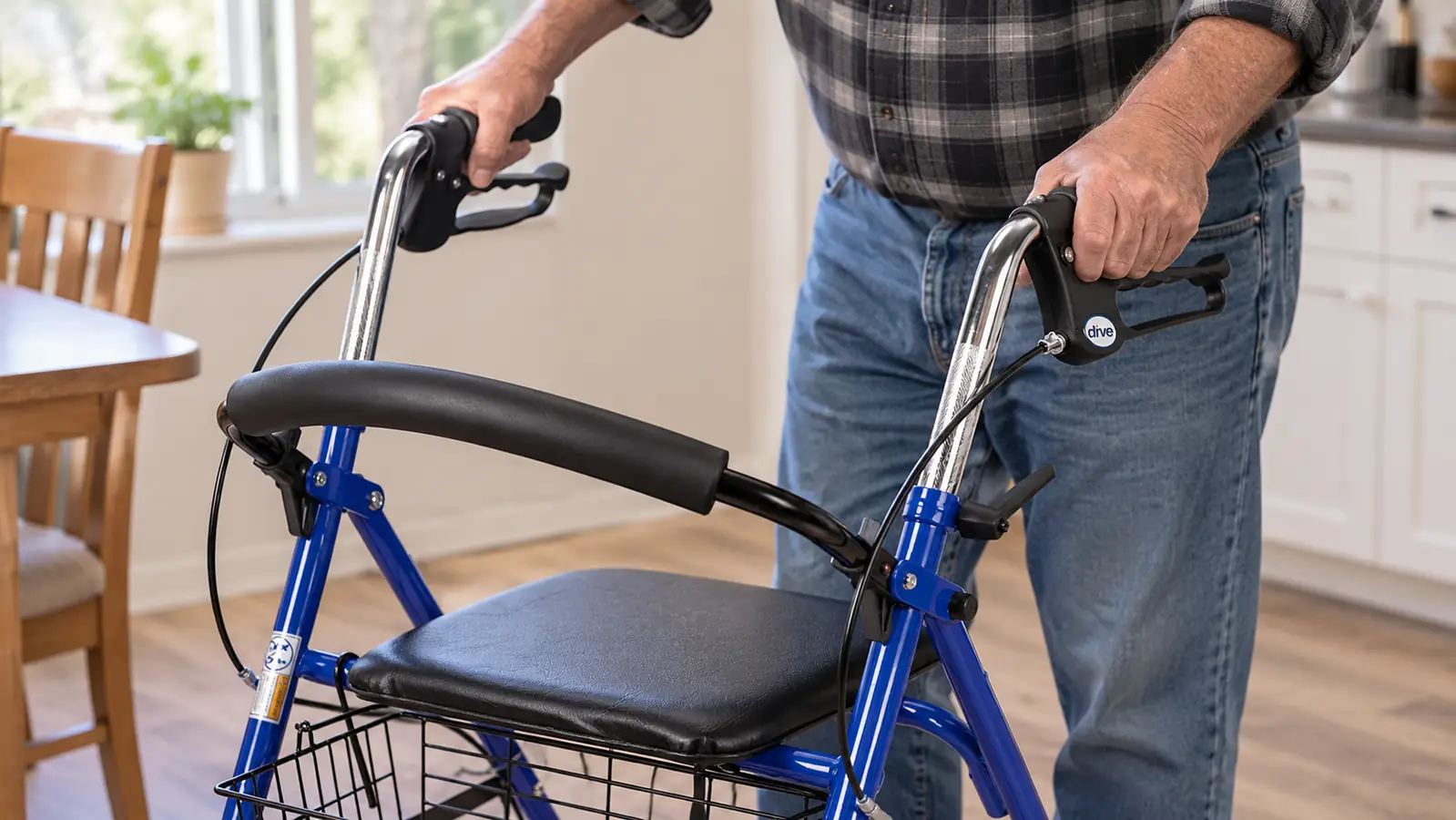
The Drive Medical Rollator Walker with Seat is an alloy steel frame that weighs 20 pounds. The listed weight capacity is 350 pounds. The handles adjust to a maximum height of 35 inches, and the minimum height recommendation is 59 inches. The wheels are 7.5 inches. The back support folds up and comes off. The warranty is a limited lifetime. Those are the numbers from the listing, not my guesses. At five foot ten and about 210 pounds, I had the handles two notches from the top and the frame did not flex when I pushed down on them.
| Drive Medical Rollator | Medline Rollator | |
|---|---|---|
| Stability on cracked sidewalk | Alloy steel frame, 20 pounds; stays planted when I lean on the handles. | The Medline I borrowed felt lighter and skittered more over tree roots. |
| Published weight capacity | 350 pounds. | No rating was visible on the frame I borrowed, so check the manual for the exact model. |
| Lifting into a sedan trunk | 20 pounds is a real lift at shoulder height. | The Medline I borrowed was easier to lift and fit. |
| Seat and back support | Seat with fold-up removable back support. | The Medline I borrowed had a seat, but its back did not fold down as flat for storage. |
| Wheels on thresholds and gravel | 7.5 inch wheels; rolled over the hall bathroom threshold and sidewalk seams. | Rolled fine on kitchen vinyl, chattered more on gravel. |
| Height adjustment | Height adjustment lever; maximum height 35 inches, minimum height recommendation 59 inches. | No manual came with the borrowed unit, so I cannot compare the adjustment mechanism. |
| Warranty paperwork | Limited lifetime warranty is listed. | No warranty card came with the borrowed Medline, so I cannot compare. |
| Best for | Daily use around the house and on sidewalks, heavier users, people who want a seat and back support. | A lighter user who lifts the rollator in and out of a car and walks mostly indoors. |
Read that table the way I would read a blueprint. The Drive Medical does not win every line. The Medline is easier to lift into a trunk, and that is not a small thing if you are alone and your shoulders are not what they used to be. The Drive Medical wins on the lines that matter to me at home: a published capacity, a frame that feels planted, and a back that folds down out of the way. A table that says one product wins everything is a sales sheet, not a comparison.
Where Drive Medical Rollator Wins
The first win is stability. My sidewalk has two cracked slabs and a seam that catches small wheels. The Drive Medical rolled over that seam without stopping. When I leaned on the handles to stand up from the kitchen chair, the frame stayed square. I am not a small man, and the 350 pound capacity is printed in the listing. That number matters if you are heavier or if you carry a bag in the seat. I would still check the exact model you receive, because listings change.
The second win is the back support. It folds up and comes off, which sounds like a small detail until you are trying to park the rollator beside a recliner or fit it into the back seat. The seat is useful in the kitchen and in a doctor's waiting room. The 7.5 inch wheels are the other quiet win. They are not big enough for a gravel path, but they handle a bathroom threshold and a sidewalk crack better than the smaller wheels I have used. The limited lifetime warranty is listed on the Drive Medical, and that gave me a reason to keep the paperwork in the desk drawer.
Where Medline Rollator Wins
The Medline wins on weight and transport. The one I borrowed was easier to lift into the trunk of my sedan. I could get it in with one hand and a knee, which I cannot say for the Drive Medical. If your main use is riding to appointments and walking indoors, that lighter lift matters more than a stiffer frame. The Medline also felt a little narrower going through my hall bathroom door, though I did not measure it. I am telling you what I noticed, not what the catalog says.
The Medline also has a simpler feel. The one I borrowed had no manual, so I cannot tell you how its adjustment works. I set it where it felt right and left it there. If you share the rollator with someone else and adjust it often, the lever on the Drive Medical is easier to describe and check. If you set it once and leave it, the difference is small. The Medline did not have a warranty card with it, so I cannot compare the warranty. I would not buy any rollator without the paperwork.
The one I kept by the front door
The Drive Medical Rollator Walker with Seat has the 350 pound listed capacity, 7.5 inch wheels, and fold-up removable back support I wanted for daily use. Check the exact model and today's price on Amazon before you order.
Amazon Check Today's Price on Amazon →
The Seat and Backrest Matter More Than You Think
I did not think I would use the seat. Then I started using it every morning while the coffee brewed. The seat on the Drive Medical is a place to sit for a minute, not a lounge chair. The back support is what makes it useful when you are waiting in a long line or standing at the pharmacy counter. Because the back folds up and comes off, I can push the rollator against the wall in the hall and still get by. That is the kind of detail you only learn after a week.
The Medline seat was fine for a short rest. The back on the one I borrowed did not fold down as flat, so it took more room in the trunk and in the hall closet. If you have a wide closet or a garage parking spot, that may not bother you. If you live in a small house with one narrow hall, it will. Measure your closet before you buy either one. I used a tape measure on my hall closet and found I had 22 inches of depth. The Drive Medical fit with the back folded.
The Drive Medical did not win every line in my table. It won the lines I use every day: a published 350 pound capacity, a frame that stays planted, and a back that folds out of the way.
What the Numbers Do Not Tell You
The numbers do not tell you how a rollator feels when your knee is stiff. The Drive Medical feels heavier in the hand than the Medline, and that weight is the reason it feels planted. If you have a strong helper who can lift it into the car, the weight is not a problem. If you are alone and you have shoulder trouble, it is. The 20 pounds is real. The box also lists product dimensions of 31.5 by 24.5 by 10.75 inches, which is the shipping size, not the size you walk behind. Do not confuse the two.
The numbers also do not tell you where the handle height lands on your body. My physical therapist had me stand with my arms at my sides and the handles near my wrist crease. The Drive Medical adjusts with a lever. I set it once and checked it with a marker on the tube. The maximum height is 35 inches, and the minimum height recommendation is 59 inches for the user. If you are shorter than that, do not guess. Ask for a fitting. A rollator that is too tall will make you lean, and leaning is the last thing you need.
What I Would Check Before You Buy
Check the handle height with your shoes on. Check the weight capacity on the exact model, not the brand page. Check the wheels against the worst surface you walk on. If you have a gravel path, a 7.5 inch wheel will not make it easy. Check the return policy and keep the box for the first month. Check the warranty card and put it with the manual. And check with your physical therapist before you change how you walk. I am serious about that last one.
If you are buying for a parent, watch them use it before you throw away the box. A rollator that fits you may not fit them. Watch how they turn, how they sit, and how they get up. Watch whether the back support gets in the way when they stand. Watch whether they can lift it into the car without twisting. If they cannot, the Medline may be the better choice even if the Drive Medical is sturdier. The best rollator is the one they will actually use.
Who Should Buy Which
Buy the Drive Medical Rollator Walker with Seat if you use a rollator every day around the house, on a sidewalk, or in a clinic, and you want a listed 350 pound capacity, a frame that feels planted, and a back that folds up and comes off. It is also the one I would pick if you are a heavier user or if you have a hallway where you need to tuck it out of the way. Buy the Medline if your main struggle is lifting the rollator in and out of a car trunk and you mostly walk indoors on smooth floors. If you are between sizes, get fitted. If your knee buckles on stairs, talk to your physical therapist before you use any rollator on stairs. I do not.
Start with the frame that stays put
If you want the rollator I kept by the front door, the Drive Medical Rollator Walker with Seat is the one. Confirm the model, the handle height, and today's price on Amazon.
Amazon Check Today's Price on Amazon →