
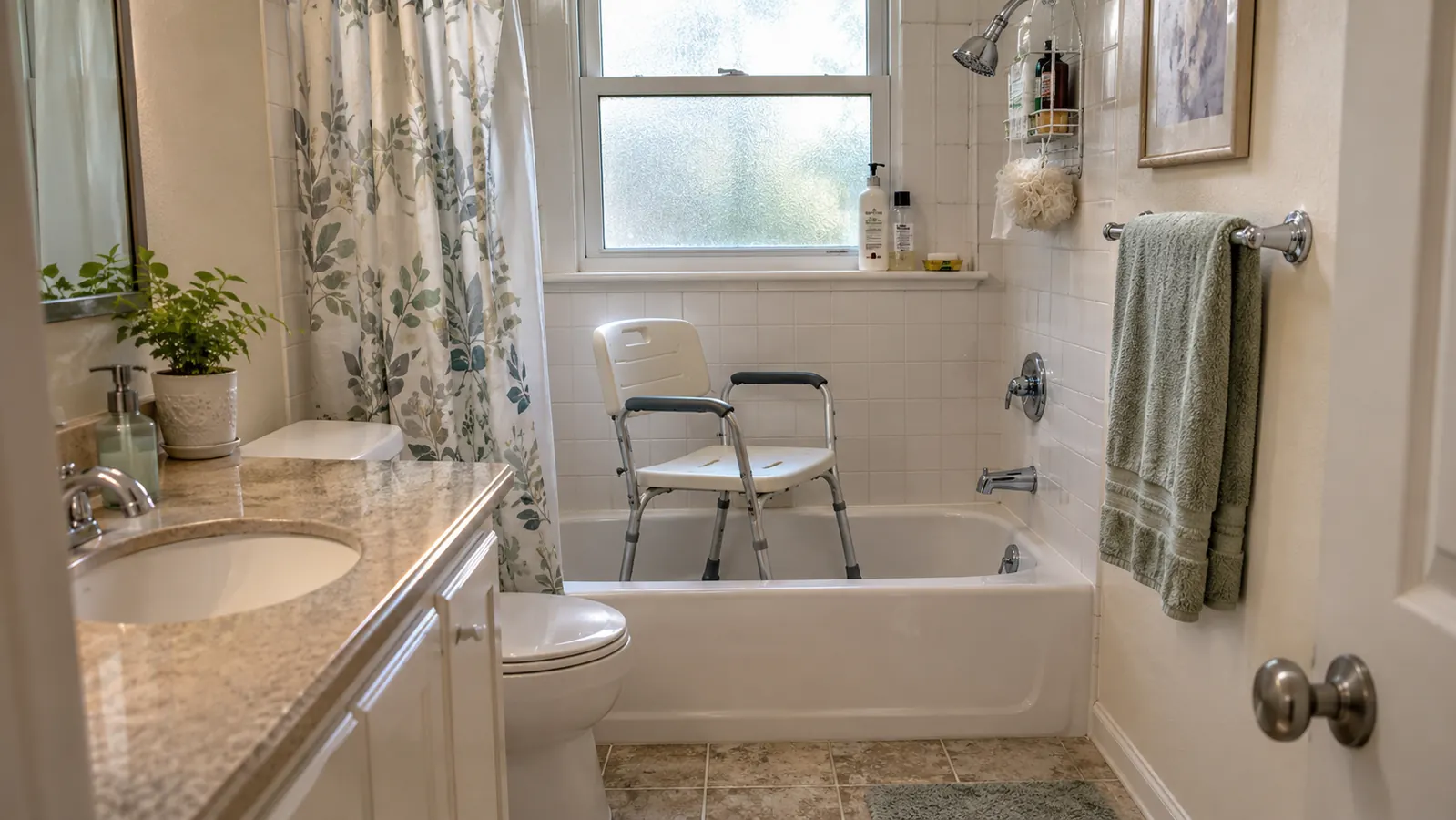
I bought the Dr. Kay's shower chair in March, and I bought it for a reason that has nothing to do with a catalog. I had gotten to where I could not stand up out of the tub without hauling on the shower curtain rod, and Joan had watched me do it enough times to say, flat, that the rod was going to come out of the wall one of these days and take me with it.
I am 71 and retired out of a machine shop, and I have arthritis in both knees. The right one buckles if I sit in one spot too long. I took a fall in my garage two winters back and got off with bruises and a sore hip, and after that my physical therapist went through my walking and my bathroom with me, one thing at a time. So I am not writing this as a shopper who read a listing. I am writing it as a man who has stood in that tub every morning since March, and who has a few things to say that the listing page leaves out.
The Quick Verdict
Light enough to lift out with one hand, narrow enough to leave the rest of a standard tub usable, and steady under me at 17 inches. The five height settings do not space out evenly, there is no back to lean against, and the spec sheet and the title disagree about the weight limit. It does the one job I bought it for.
Amazon Check Today's Price →The chair that gets me out of the tub every morning
Aluminum frame, a seat that adjusts through five heights, and side handles built into the seat frame. Same chair I have used daily since March, at today's price.
Amazon Check Today's Price on Amazon →How I Have Actually Used It
The Dr. Kay's chair lives in the tub of our one small hall bathroom and has not come out except to be wiped down. I set it at 17.2 inches, which is the next to highest of the five settings, and I set it there because that puts the seat roughly level with the tub rim and gives my knees the least to do. I get in with one hand against the wall, sit down, wash, and stand up the same way. That is the whole routine. It has not changed since the first week, and that is the highest compliment I know how to pay a piece of bathroom equipment.
It weighs 2.1 kg, a little over four and a half pounds, so I can lift it out of the tub with one hand and stand it against the wall when Joan wants the tub clear for a soak. I did not think about that before I bought it. It turns out to be the difference between a chair you use and a chair that becomes one more thing to step around. A heavy chair that stays put because you cannot lift it is not really an aid. It is furniture.
The handheld sprayer is the piece I did not expect to care about. I hold it in my right hand and brace my left on the side handle, and rinsing my feet stopped being a negotiation with my knees. That never showed up on a bullet point anywhere on the listing. It is just what happens when a chair has handles where your hands naturally fall, and it is the reason I stopped dreading the last two minutes of a shower.
The seat measures 16.7 by 10.5 inches. That is a perch, not a recliner, and I want to be honest about that up front. There is no shifting around on it. You sit, you wash, you get up. If you are the type who likes to sit under the hot water and let it run down your back for twenty minutes, this is not the chair for that, because the seat is narrow and there is nothing behind you.
The side handles are built into the seat frame, and I use them every morning, mostly to steady myself on the way down and to hold the sprayer while I rinse. Joan uses them to hold a washcloth. They are handy and they are where my hands go without me thinking about it. They are not armrests, though, and I would not want anybody thinking they can shove down on them the way you shove down on the arms of a chair to push yourself up.

How It Has Held Up
Six months is not a lifetime, but it is long enough for a wet bathroom to find the weak spot in anything. The Dr. Kay's frame is aluminum, so it does not rust, and this one has not. What I watch instead is the joints, because a chair that lives in water gets a hard workout at every connection point. Nothing has worked loose enough for me to notice, and I am the kind of man who puts a wrench on things out of habit.
The finish wipes down with a rag. I do it once a week after I shower, mostly because our water is hard and leaves a film on everything it touches. No pitting, no dull grey patches, no flaking at the corners. Joan says I am fussy about it. I say a metal object that sits in a tub for six months will tell you plain enough what it is made of, and this one has told me it is made of aluminum.
The thing I would watch on any of these chairs is whether the legs stay put where they meet the tub floor. Mine have not moved. Our tub floor is a flat surface, though, and if yours has a molded seat in it or a slope toward the drain, that is a different situation, and you will find out in week one rather than week twenty. Set it in the tub dry and put your weight on it before you ever get in with the water running.
What Nobody Tells You About the Height Settings
The seat adjusts to five heights: 13.4, 14.4, 15.4, 17.2, and 18.5 inches. Read that list again, because there is a gap in it. The first three steps are an inch apart, then the fourth jumps nearly two inches, then the fifth is a bit more than an inch above that. If your tub wants a seat at, say, sixteen inches, you are choosing between 15.4 and 17.2 and living with whichever is less wrong.
Then there is this. The attribute table on the listing gives a minimum height of 14.5 inches, and the product description on that same listing gives 13.4 inches as the lowest setting. Both numbers are printed on the same page. I put a tape on mine at the bottom setting and got close enough to 13.4 that I believe the description, but a person ordering deserves to know the page does not agree with itself. When a spec sheet is careless in one place, you check it in the others. That is not suspicion, that is just how you buy things.
The reason the gap matters is not fussiness. Too low and you are squatting to sit, which is the exact motion that hurts me. Too high and you are sliding off the front edge and catching yourself with your heels. My physical therapist told me to set it so my feet are flat on the tub floor and my knees are roughly level with my hips when I am seated. I got there at 17.2. A man five inches shorter than me is going to land somewhere else on that list, and he should work it out on paper before he orders, not in the tub at six in the morning.
The steps are an inch, an inch, an inch, nearly two, then an inch and a bit. If your tub wants a seat in that gap, you cannot split the difference later.
The Spec Sheet Argues With Itself
The title of the listing says 300 pounds of support. The attribute table on the same listing gives 350 pounds as the maximum weight recommendation. I do not know which one is right, and I am not going to pretend I ran a test. I am telling you the page has two numbers on it, and that is the sort of thing you want to know before you trust either one.
What I can tell you is what I weigh and what happened. I am a shade over two hundred pounds, and the frame does not flex, does not creak, and does not walk itself across the tub floor when I stand up. The legs are the same gauge top to bottom, which is more than I can say for a folding chair I threw out years ago. If you are well north of three hundred pounds, I would take the smaller of the two numbers seriously and ask the seller in writing which one they stand behind. A wet bathroom is a poor place to find out a number was decoration.
The other way to read a spec sheet is to notice what is not on it. There is no backrest listed. There is no mechanism listed for locking the chair down to anything. What you are buying is a freestanding aluminum frame with a seat and two handles, and that is exactly what showed up. It is fine. It is just worth knowing before the box arrives and you go looking for parts that were never promised in the first place.

What It Does Not Do
It does not give you a back to lean against. You sit upright the whole time. For a shower that is fine, since you are in and out in ten minutes. For a person with a bad lower back who wants to lean while they wash their feet, it is not fine, and this is the single most common thing I would want a buyer to understand before ordering.
It does not get you over the tub wall. This is a chair that sits down inside the tub, which means you still have to step over the rim and lower yourself in. If the step over is the part that scares you, this chair solves the wrong half of your problem and you want a transfer bench instead. Those are a different animal, and I would not let anybody talk you into the wrong one because it was on sale.
And it does not do the work of a grab bar. Nothing that sits loose in a wet tub is a substitute for something bolted into the studs behind the tile, and no chair anywhere is a substitute for somebody looking at how you actually move. My physical therapist walked the bathroom with me and told me where to put the bar. That visit was worth more than the chair was, and I would say the same if the Dr. Kay's chair had cost me twice what it did.
What I Liked
- At 2.1 kg, light enough to lift out of the tub with one hand
- Five seat heights, so most tub and leg combinations can be matched
- Side handles are built into the frame and get used every single day
- Frame stayed steady under a little over two hundred pounds with no flex
- Narrow footprint leaves the rest of a standard tub usable
- Aluminum frame has not rusted or pitted after six months of wet use
Where It Falls Short
- No backrest, so there is nothing to lean against
- Height steps skip from 15.4 to 17.2 with nothing in between
- Listing title says 300 pounds while the attribute table says 350
- Seat is 16.7 by 10.5, a perch rather than a place to sit a while
- Side handles are handles, not armrests you can push up from
- Listing states two different minimum heights on the same page
Before You Order, Measure Three Things
First, the inside floor of your tub, front to back. The chair needs to sit flat, and if that floor has a slope or a molded seat built into it, that changes where the legs land and whether the seat stays level. Second, the tub rim height, because you want the seat at or a little below it so you are not climbing up onto the chair to get in. Third, your own knee height when you are seated on a hard kitchen chair, because that number tells you which of the five settings to start with.
I would add a fourth, and it is not a measurement. Have somebody watch you get in and out one time. Joan caught two things I was doing without knowing it, both of them reaching for the wall in the wrong place at the wrong moment. You cannot see your own habits. A spouse can, and she will tell you whether you want to hear it or not.
One more note about the room itself, since I have your attention. Our hall bathroom floor is tile, and tile is slick when it is wet. A towel on the floor does more good than a mat that slides out from under you. None of that is the chair's fault. It is just the rest of the room the chair sits in, and the chair cannot fix it.
Who This Is For
This is for a person who can still step over a tub rim and lower themselves down, but who cannot do it safely without something to sit on and something to hold. That is me exactly. It is also for the adult child buying for a parent who will not ask for help, because it is simple enough and light enough that it does not feel like a declaration that somebody is failing. It is a chair. It goes in the tub. Nobody has to make a speech about it.
One word to the son or daughter doing the buying: do not surprise them with it. Tell them you are getting a chair for the tub and why. My daughter is an hour away and she asked me straight out what I needed in that bathroom, and because she asked instead of announcing, I told her. A box that shows up unannounced gets shoved in a closet out of pride. A box that was discussed gets used.
It is also a good fit for a shared bathroom. Because it lifts out and stands against the wall in about four seconds, the person who does not need it is not tripping over it or moving it out of their way every evening. In a one-bathroom house, that counts for more than the spec sheet does.
Who Should Skip It
Skip it if you need a back. Skip it if the step over the tub wall is the part that worries you, because this chair does nothing at all for that. Skip it if you need arms you can push down on to stand up, because the side handles on this one are for steadying and for holding a sprayer, not for pushing off. And skip it if you are buying it instead of having the conversation with your doctor or your physical therapist about the bathroom.
I know how that sounds coming from a man who writes about shower chairs. I am saying it anyway, because the chair is a tool and the fitting is the part that keeps you off the floor. Buy the chair. Get the fitting first. That is the order I did it in, and I would do it the same way again.
If you can still step into the tub, this chair handles the rest of it
Five seat heights, side handles built into the frame, and 2.1 kg of aluminum you can lift out with one hand. Six months in, mine is still in the tub. Check today's price before you decide.
Amazon Check Today's Price on Amazon →