

Two pieces of bathroom gear get handed to the same people for the same reason, and they do not do the same job. The Medline toilet safety rail gives you something to push against while you sit down and stand up. A raised toilet seat shortens the distance you travel to get there. One is a handle. The other is a platform. If your knees ache but your balance is still decent, the rail earns its keep. If the drop down to a standard seat is the part that makes you wince, the raised seat is the piece that helps. That is the short answer. The rest of this is how I got to it, in a three-foot-wide hall bathroom with a tub-shower combo and no room for either one to be in the way.
Context, because it matters for how you read the rest. I am 71, a retired machinist, arthritis in both knees and a lower back that stiffens if I sit through a long sermon. My right knee has buckled twice, once on the porch steps and once on the garage floor, and the garage one is what sent me to a physical therapist. Joan and I live in a one-story brick ranch outside Huntsville. One bathroom. Two steps up at the porch. Vinyl plank in the kitchen, carpet in the bedrooms, and a hall bath that was built when nobody in the house was over 40. Every piece of gear I write about gets measured against that room.
| Medline Safety Rail | Raised Toilet Seat | |
|---|---|---|
| What it does | Puts two handles at arm height beside the seat so you can push up with your arms | Raises the seat surface so there is less distance to lower down and lift back up |
| Something to hold onto | Yes. That is the entire job | None, unless you pick a model that comes with arms |
| Added seat height | None. Your seat stays where it is | A few inches on most models, which is what it is for |
| Adjustability | Arm height and width adjust, and the handles rotate back to open up the position | Fixed height once it sits on the bowl, and fit depends on the bowl shape |
| One bathroom, two people | Folds and lifts out of the way, 4.4 pounds, moves between bathrooms | Lifts off the bowl, but you need somewhere dry to set it down |
| Using it with an elevated seat | Fits standard or elevated seats, so it can go around a raised seat | Is the elevated seat, so it does not stack with itself |
| Weight capacity | 250 pounds on the listing | Varies by model, so check the label on the one you are looking at |
| Standing up from a low seat | Does nothing about the drop. You still travel the full distance | Cuts the drop, which is the part that hurts after knee or hip work |
Where the Medline Rail Wins
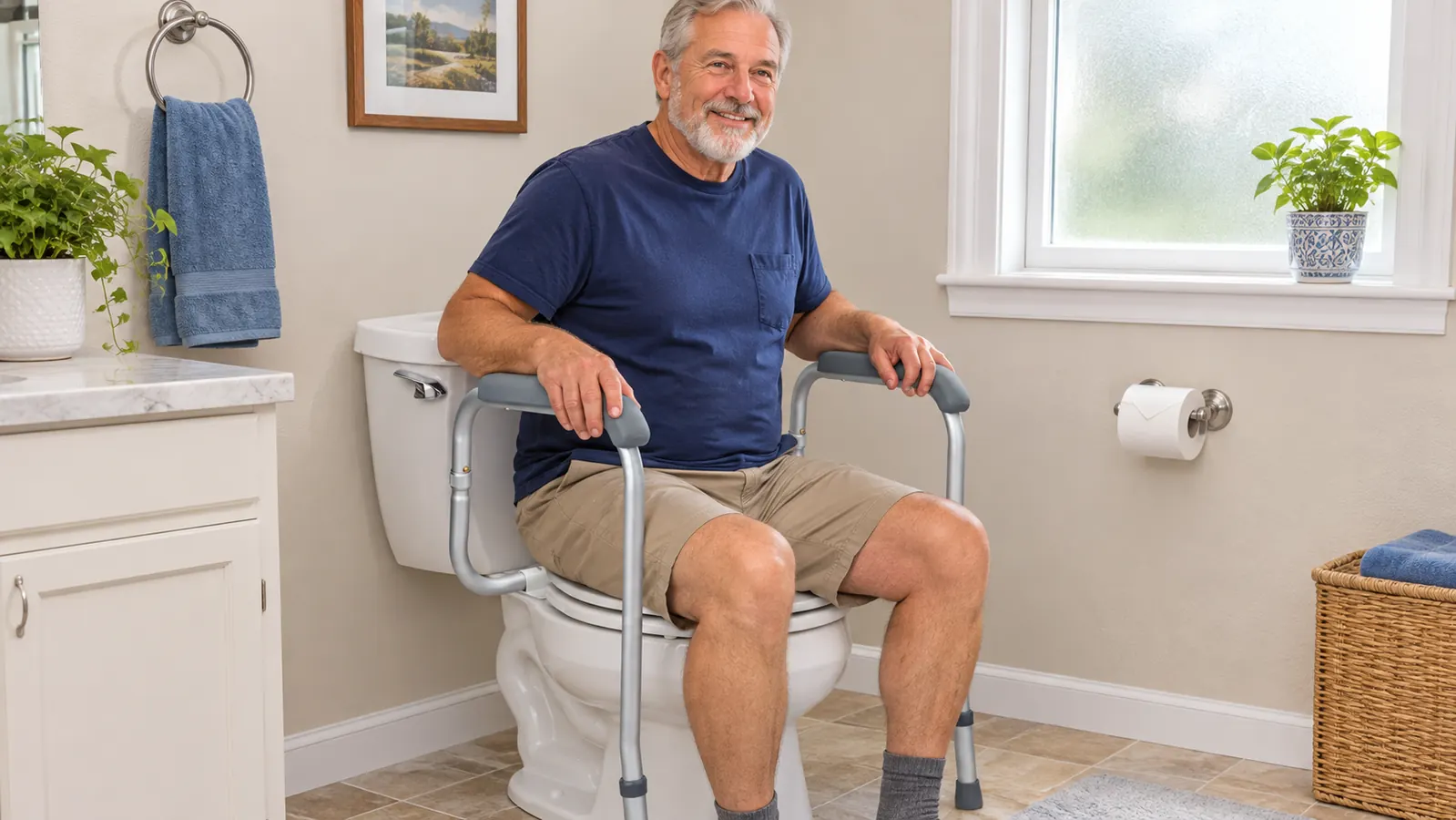
A rail wins on the one thing a seat cannot touch: it lets your arms do the lifting. When I sit down now, I put a hand on each handle and lower myself like I am easing down onto a shop stool. When I get up, I push straight down through my palms and my knees only have to finish the job. That is the whole mechanical idea, and it works because the handles sit up at arm height instead of down at the seat. The frame is high-strength aluminum, so it does not flex when you lean on it. I have leaned on mine harder than I care to admit.
The adjustment is what makes it fit a real bathroom instead of a catalog photo. Arm height and width both adjust, and the handles rotate back so you can open the position up wider. The height range on the listing runs from 27.5 to 32 inches, and the listing also gives a seat back interior height of 31.5 inches and a seat depth of 16.75 inches. Those last two are the numbers to hold against your own toilet before you order, because a rail that crowds the tank or fouls the seat back is a rail you will quit using inside a week. Mine has sat where I set it and has not wandered.
Then there is the part nobody mentions until they have a bathroom the size of a closet. The Medline rail folds, and it weighs 4.4 pounds, so it comes out of the way when Joan needs the room or when the daughter visits with the grandkids and the bathroom has to be a bathroom again. It moves between bathrooms, and it will go in a car trunk if you are traveling. What it does not do is add an inch of height. If the drop down to the seat is the thing that hurts, the rail will steady you at the top and bottom of that drop, but it will not shorten it. That is the honest limit, and it is why the next section exists.
Where a Raised Toilet Seat Wins
The raised seat wins on height, and height is not a small thing. A standard toilet sits low, lower than a kitchen chair, and after knee or hip work that distance becomes the whole problem. A raised seat lifts the seating surface a few inches on most models, which shortens the travel in both directions. You lower less far. You lift less far. Your knees stay inside a range they can still manage. No handle does that. A handle gives you leverage, not altitude, and no amount of squeezing a grip changes the distance from your hip to the bowl.
It also takes up less floor space, and in a three-foot bathroom that counts for something. It sits on the bowl and stays there, with nothing standing beside the toilet for you to step around at two in the morning. Some models come with their own arms, which gets you partway to what the Medline rail does, though the arms on most raised seats are shorter and lower than a dedicated rail. And if your shoulders are the problem, if pushing down through your hands aches, a raised seat asks almost nothing of your upper body. That is a real advantage, and it is why my physical therapist brought one out before we talked about anything else.
Put a handle where your hands already reach
The Medline toilet safety rail adjusts from 27.5 to 32 inches, folds to 3 inches deep, and weighs 4.4 pounds, so it fits a small bathroom and gets out of the way when it has to. Rated to 250 pounds.
Amazon Check Today's Price on Amazon →Two Weeks With Both in One Small Bathroom
My physical therapist handed me a loaner raised seat before we discussed anything else, and I ran it for two weeks. The first morning I noticed the difference in the drop immediately. I sat down without that bracing flinch I had gotten used to. What surprised me was the other end. Standing up from the raised seat, I still had nothing to push against, and I caught myself putting a hand on the edge of the tub, which is exactly the habit that left a bruise on my forearm the year before.
So I set the Medline rail back over the toilet with the raised seat still on it. The listing says it adjusts to fit standard or elevated seats, and in my bathroom that held true. On the third morning I ran them together. Pushing up off the handles with the raised seat underneath was the steadiest that room has felt since before the garage fall. If I had to put it in one line, the seat took care of the distance and the rail took care of the wobble at the end of it.
I kept the rail and sent the loaner seat back, and the reason was not that the seat failed. It was that Joan and I share that bathroom, and the raised seat had to live on the edge of the tub whenever it was not on the bowl, which meant stepping around it in the dark. The rail folds. I can lift it out of the way with one hand and set it back down without looking. For my knees, the rail covered enough of the problem that the extra height turned into a nice-to-have instead of a need. Your situation will land somewhere else, and that is fine.
The Medline rail weighs 4.4 pounds and folds to 3 inches deep. That is the reason it is the one that stayed in a three-foot bathroom.
The Numbers on the Listing, and What They Mean in a Bathroom
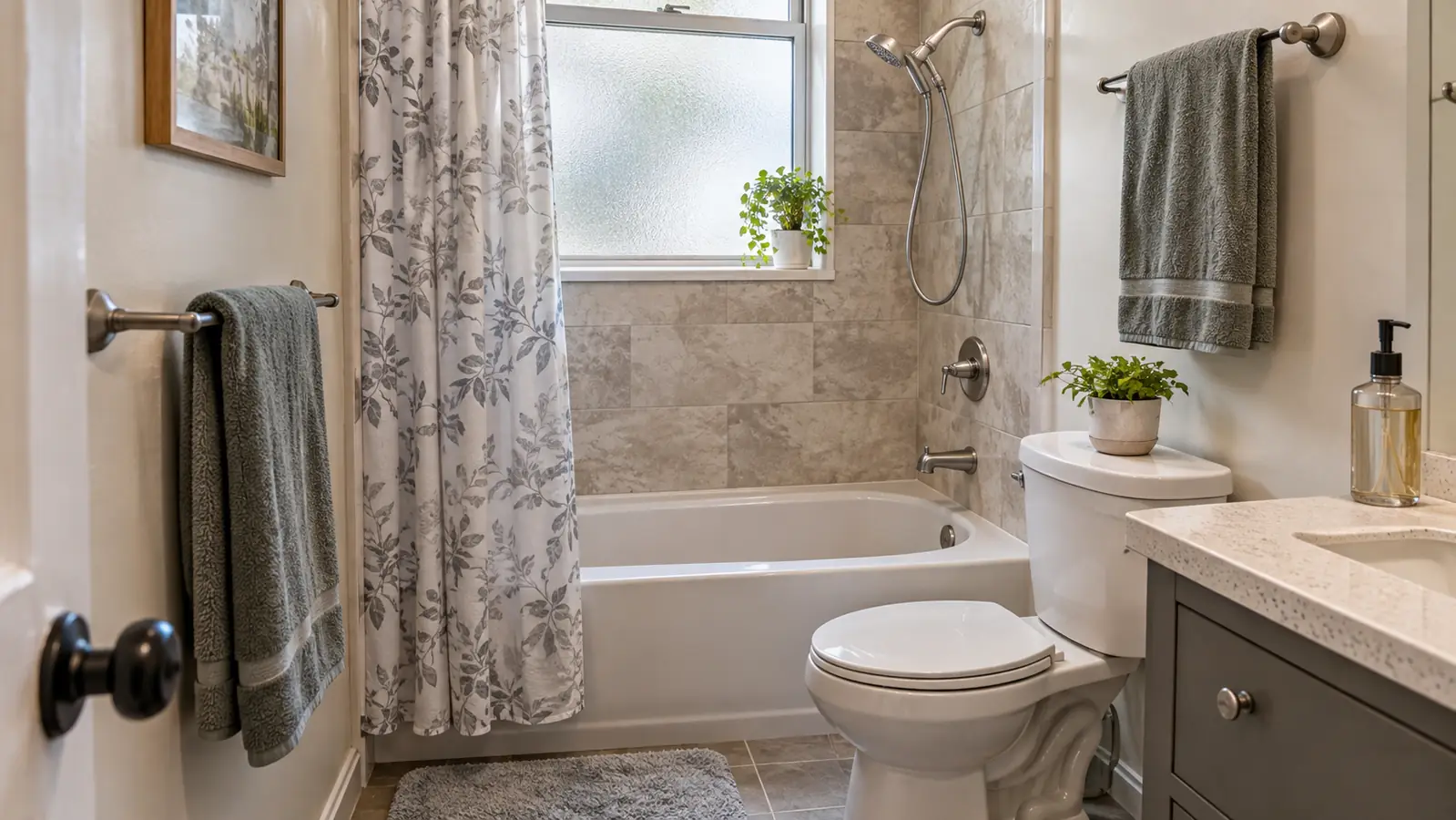
Before you order either one, take two measurements. Sit on your toilet the way you normally do and measure from the floor to the crease of your elbow with your arm hanging relaxed. That is roughly the arm height you want, and it is the number to compare against the 27.5 to 32 inch range on the Medline rail. Then measure the clear floor space on both sides of the bowl. The rail is 19.8 inches wide overall and 29 inches deep, and if your toilet is wedged between a tub and a wall, those figures are going to decide whether this works in your house.
The rest of the listing: 4.4 pounds, 3 inches deep when folded, high-strength aluminum frame, rated to 250 pounds, and a limited warranty against defects in materials. The 4.4 pounds matters more than it sounds. Anything much heavier than that, I am not going to move twice a day, and gear you do not move is gear that stays in the way. The 250 pound rating is the one to read honestly. If you are close to that line, or over it, look at the listing yourself and talk to the seller before you order, because that is not a number to fudge.
One more thing, and I will say it plainly because I am not qualified to say anything else: this is hardware, not a treatment plan. Which of these you should be using, and whether you should be using either, is a question for your doctor or your physical therapist. Mine checked how I walk and told me what to work on. The gear supports that work. It does not replace it, and no number on a product listing can tell you which one your knees need.
Who Should Buy Which
Buy the Medline rail if your knees are the problem and your balance is still reasonable. If you can rise from a kitchen chair without pushing off both arms, but the toilet sits lower than a chair and that is the part that catches you, the rail addresses exactly that gap. Buy it if you want to keep the toilet you already have, if you share the bathroom with somebody who does not need help, if you travel and want something that folds into a trunk, or if you want the option of running it alongside a raised seat later on.
Buy a raised toilet seat if the height is the problem and nothing else. If your therapist or doctor has told you the seat is too low, if you are weeks out from knee or hip work and range of motion is the issue, or if pushing down through your hands and shoulders hurts, the seat is asking less of you. Buy it if your bathroom has no floor space beside the bowl for a frame to stand in, and buy one with arms if you want some of what the rail gives you without the footprint.
Buy both if you can, and do not let anybody tell you that is redundant. The listing for the Medline rail says it adjusts to fit standard or elevated seats, which means the two are built to sit in the same bathroom. The seat handles the distance. The rail handles the push. If you are not sure which problem you have, sit down on your toilet and pay attention to which part makes you hesitate. That hesitation is your answer, and it is worth more than any review, including this one.
Fix the push first. Add the height if you still need it.
The Medline toilet safety rail is aluminum, folds flat, adjusts from 27.5 to 32 inches, and is rated to 250 pounds. Measure your elbow height and your floor clearance before you order, and check with your physical therapist about fit.
Amazon Check Today's Price on Amazon →