
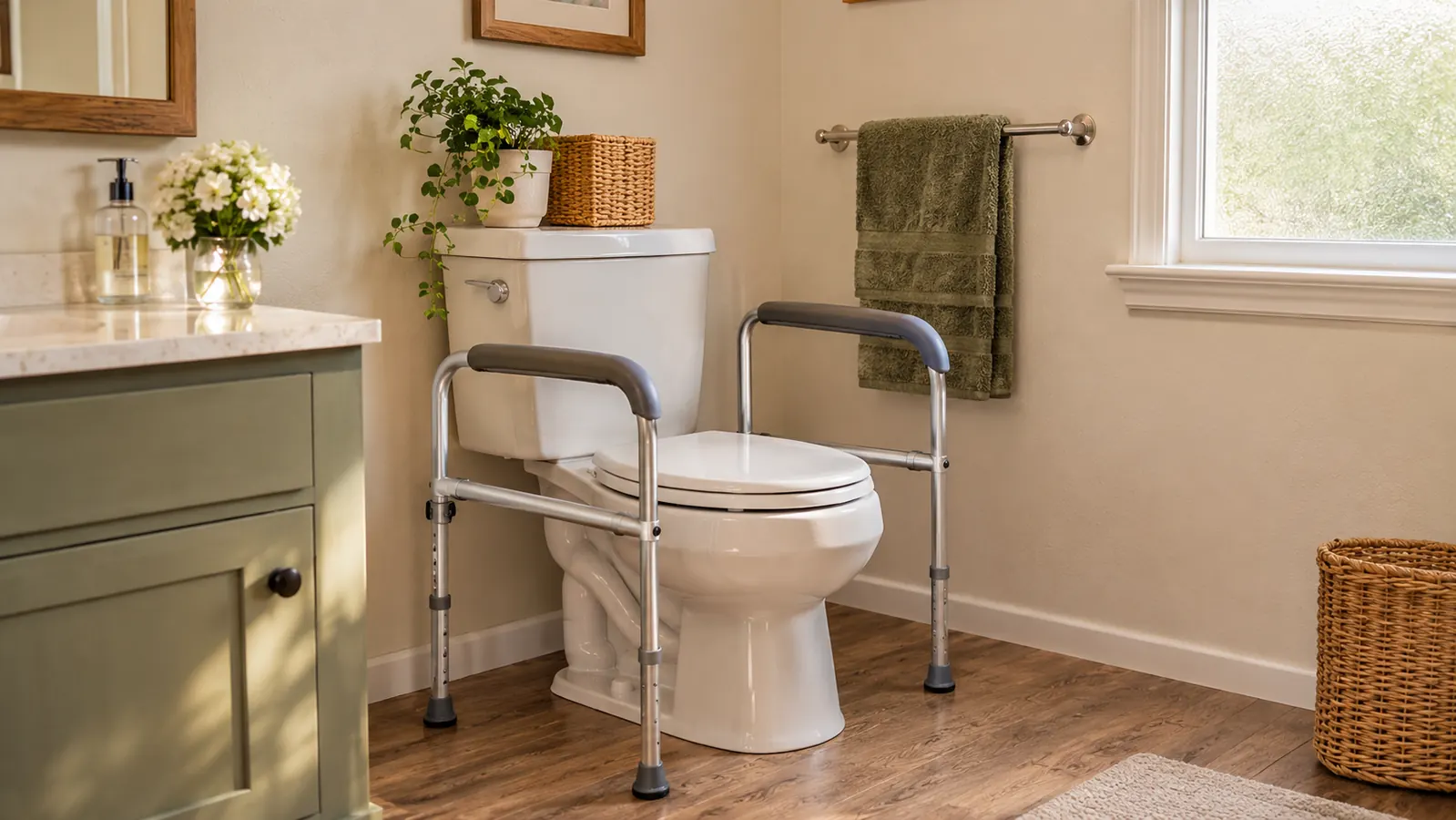
I fell in my garage two winters back. Bruised hip, bruised pride, nothing broken. My family doctor looked me over and said the thing doctors say at my age: figure out why it happened before it happens again. My physical therapist had me sit in a low chair and stand back up without using my hands. I could not do it. I am 71, a retired machinist outside Huntsville, Alabama, and I have arthritis in both knees plus a lower back that stiffens up if I sit more than ten minutes. Standing up from a low seat is the whole job, and the toilet is the lowest seat in my house.
Before the Medline rail, I tried a raised seat first. It put me higher, which helped some, but it gave me nothing to push against, and pushing is what my knees need. I thought about a grab bar screwed into the tile behind the toilet, then thought about the plumbing in that wall and the fact that my one small hall bathroom has a tub-shower combo eating most of the width. What I wanted was something that did not need a drill, did not need a plumber, and could ride in the trunk of the sedan when Joan and I drive an hour to our daughter's place on weekends.
The Quick Verdict
A folding aluminum rail that fits around a standard or elevated seat, adjusts in height and width, and holds up to daily use. It is not furniture, it does not fasten to anything, and it will not cover a bad transfer on its own. For steadying yourself going down and coming back up, it has done its job in my bathroom for six months.
Amazon Check Today's Price →Four point four pounds of aluminum that ended the argument with my bathroom
Adjusts from 27.5 to 32 inches, folds flat, and fits around a standard or elevated seat. The Medline rail is the piece of gear I stopped thinking about after the first week, which is the highest compliment I can pay a bathroom aid.
Amazon Check Today's Price on Amazon →How I've Used It
It came in one box and weighed 4.4 pounds, so I carried it up the two steps of my front porch in one hand with a coffee in the other. No assembly marathon, no bag of loose hardware to chase around the vinyl plank. I set it around the toilet in the hall bath, opened it up, and set the arm width where it did not crowd my hips. Then I set the arm height so my hands land where they want to land when I reach back and down. That took about ten minutes, most of it me standing there deciding, not fiddling with the rail.
My routine is the same every morning and it has not changed in six months. Right hand to the arm, weight back, lower down. Then the reverse: hand on the arm, lean forward, push up through the left leg, which is the better of the two. My right knee is the one that buckles after I have been sitting a while, and the hand goes down on the rail before that knee bends, not after. That order is the entire reason the thing works for me. It is not lifting me. It is giving me something solid to time myself against.
The first week I was deliberate about it, the way you are with anything new. I put a strip of blue tape on the vinyl plank at the near arm so I would know if the rail had shifted overnight. It had not, not by a quarter inch, and after ten days I peeled the tape up and threw it away. The night I stopped thinking about it was a Thursday in June, around 2 in the morning, when I got up half asleep and my right knee gave that little warning shimmy it does. My hand found the arm without me looking for it. That is the whole test, as far as I am concerned, and the rail passed it.
Joan uses it too, mostly at night when she is half awake and does not want to think about where she is stepping. The handles rotate back, which she likes because she can set them wide for her and I can set them narrower for me without tools and without an argument. When she scrubs the bowl she lifts the rail away, cleans, and sets it back. It goes back where it was every time because the width is set and it sits the same way. I have also folded it flat and laid it in the trunk of the sedan for the drive to our daughter's house. Folded, it is 3 inches tall by the spec sheet, and it did not fight the groceries.

The Adjustment Range, and Why It Mattered in My Bathroom
The number that sold me was 27.5 inches at the low end of the height range, up to 32 inches. My hall bath is not a big room and the toilet sits low, closer to the floor than the one at our daughter's house. A rail that only came in one height would have left me reaching down or reaching up, and either one puts a shoulder into a bad position. The other numbers worth writing on the back of the receipt are a seat depth of 16.75 inches and a seat back interior height of 31.5 inches. Those are the figures that tell you whether it will sit around your toilet or fight it.
I measured the way a machinist measures, which is twice and then once more with a different tape. Floor to the top of the closed lid was 17 inches in my hall bath and 19 at our daughter's house, which is exactly the kind of two inch difference that makes a fixed rail useless in one room and fine in the other. The rail's arm sits above the seat, so what you are really setting is where your hands land, somewhere between your lap and your chest. I ended up about two thirds of the way up the adjustment range, with room to go higher if my knees get worse and I want a taller seat under it. That margin is worth paying for.
The footprint is listed at 29 by 19.8 by 3 inches. In plain terms, it takes up a little more floor than the toilet itself, which matters in a bathroom the size of a closet. I measured before ordering and I would tell you to do the same, because the difference between fitting and not fitting in a hall bath is a couple of inches and a bad mood. It is rated for 250 pounds. I am well under that and Joan is lighter still, but I like knowing the margin is there rather than wondering about it every morning.
Six Months of Daily Use, Hardware Included
Here is where a machinist earns his keep. I have had this rail in a bathroom that gets steamed up twice a day since spring, and the aluminum frame has not rusted, spotted, or gone chalky at the joints. The fold mechanism still snaps to where it should. I check the fasteners every few weeks with a screwdriver I keep in the kitchen drawer, and I have not found one that worked loose on its own. That is a low bar for a piece of equipment and an alarming number of things fail to clear it.
I keep a pencil mark on the inside of the bathroom cabinet door for the checks, one tally per month, which is the kind of thing a man does when he has spent forty years keeping a machine log. Six tallies now. In that time I have tightened nothing, wiped the frame down with a damp rag maybe four times, and found one small spot of soap scum in the fold joint that came off with a thumbnail. An Alabama summer will put humidity in a bathroom that a January morning cannot match, and the aluminum did not care. If this had been painted steel I would be telling you a different story.
The thing I watch is movement at the base, because a rail that walks across the floor is worse than no rail at all. Mine sits on vinyl plank and it stays put under a normal sit and stand. What it will not do is take a hard sideways shove. It is a frame that sits around the seat, not a bar bolted into studs, and the two do different jobs. If I grab it and lean my whole weight to one side, I can feel it start to think about sliding. Knowing that has made me use it correctly, hand down and weight back, instead of treating it like a pipe I can swing from.
It has held 250 pounds of rated capacity, sat in shower steam twice a day for six months, and not one fastener has backed out. The rest is judgment about what a rail that does not bolt down can honestly do for you.
Where It Falls Short
The honest limitation is the one I just described. This rail steadies you. It does not catch you. If your therapist has told you that you need a fixed grab bar, this is not that, and buying it instead of doing the wall work is a decision you will regret in the one moment that matters. I may still put a bar in the tub-shower wall behind the toilet, because the two together cover more ground than either one alone.
Second complaint: it is in the way. A rail that sits around the seat occupies floor space in a room that had none to spare, and I have barked my shin on the near arm exactly twice. Third, the height and width are set-and-leave settings, not something you fiddle with daily. Set it once, check it when you clean, and forget it. If you need to change the arm position every time you sit down, this is the wrong design for you and you should be looking at a bar on the wall instead.

What I Tried Before This
The raised seat was my first attempt and it solved half the problem. Height, yes. Something to push against, no. I wrote up the full side-by-side in my notes on the Medline rail versus a raised toilet seat, and the short version is that they fix different things. The commode chair I borrowed from a neighbor was sturdier than either one and far too big for my hall bath, so it lives in the garage for power outages and nothing else.
The Saturday I almost installed a bar, I got as far as the stud finder and the pencil. Behind my toilet is tile over the original plasterboard, and the one stud I could find sat about four inches to the left of where a bar would need to be to do me any good. That is a decision to make with a contractor and a checkbook, not with a Saturday and a bad attitude. I put the drill back in the garage and ordered the rail instead. I am not sorry. The bar is still on my list for the tub-shower wall, where the framing is friendlier, and when it goes in the two will work together.
The installed grab bar is still the gold standard. It is also drywall, studs, a level, and a Saturday. If you own your house, have a stud where you need one, and someone to hold the other end of the level, do that first. The Medline rail is for the rest of us, the renters, the people with tile over plasterboard, the people who want the same steadying hand in two bathrooms and in a trunk. I also keep a short list of the reasons a rail earns its place at all, which I put down in ten reasons a toilet safety rail is worth installing, and none of those reasons require a drill.
What I Liked
- Folds flat and fits in a closet or the trunk of a mid-size sedan, so it travels with you
- Arm height adjusts from 27.5 to 32 inches and the width adjusts too, which is what makes it fit a narrow hall bath
- Fits around a standard seat or an elevated one, so it did not become useless when I tried a raised seat
- Aluminum frame, 4.4 pounds, no rust or spotting after six months of daily shower steam
- Rated to 250 pounds, and the fasteners have not worked loose with a few minutes of checking
Where It Falls Short
- It does not fasten to the floor or the wall, so it steadies you rather than catching you
- It takes up real floor space in a small bathroom and the near arm is easy to bark a shin on
- Height and width are set-and-leave settings, not something to adjust every trip
- Not a substitute for an installed grab bar if your physical therapist says you need one
Who This Is For
This is for the person who can stand and walk but does not trust the sit and the rise, which is most of us past 70 with a knee that talks back. It is for a small bathroom where a bolted bar is not happening this year. It is for the adult child setting up a parent's house who wants one piece of gear that works in the hall bath and travels to the guest bath when the family visits. If you can put a hand on something solid and push, this rail gives you the something solid in the one room where there was nothing.
Who Should Skip It
Skip it if you need to put full body weight onto whatever you are holding, if you pivot from a wheelchair, or if you have been told you need a fixed support. Ask your physical therapist to watch you stand up before you buy anything, mine did and it changed what I ordered. Skip it if your bathroom is so narrow that the 29 inch footprint blocks the door swing. And skip it if you want to install once and never think about it again, because a rail that sits on the floor wants a look now and then. That look takes me two minutes a month. For a bathroom that had no answer at all, two minutes is a fair trade.
The rail I stopped noticing after the first week
Set the arm height once, set the width once, and it is the same steady hand every morning. Rated to 250 pounds, folds flat for the trip to your daughter's house, and costs less than the plumber who would come out to look at your wall.
Amazon Check Today's Price on Amazon →