
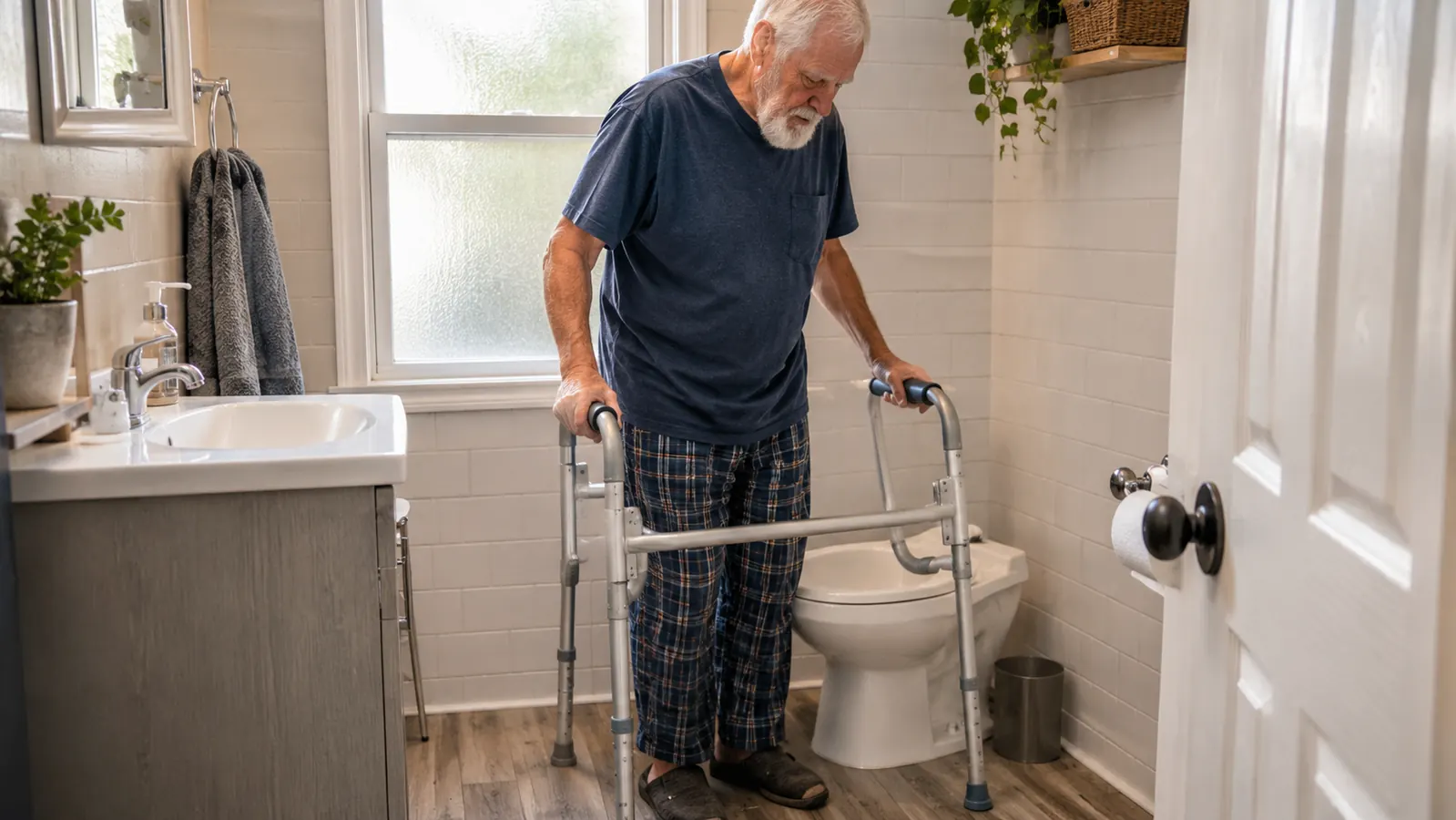
Most reviews of a bathroom rail read like they were written by somebody who set it up once for a photograph and then went home. Mine is not that. I am 71 years old, I have arthritis in both knees and a lower back that locks up if I sit through a long dinner, and I have had the Medline toilet safety rail standing around the commode in my hall bathroom since early spring. My name is Lyle Haverkamp. I spent 41 years in a machine shop before I retired, so I have a fair feel for what a piece of aluminum is doing when you put your weight on it, and I have a fair feel for when a joint is going to loosen up on you.
Here is the short version, and then I will take my time. This rail is not a grab bar. It is not screwed into a stud and it is not meant to be. It is a folding aluminum frame that straddles the toilet and gives you two handles at a workable height to push up from, and once you accept that, the Medline rail is a sensible piece of equipment for what it costs today. If you buy it expecting a permanent fixture bolted through the drywall, you are going to be annoyed, and the annoyance will be about your expectations and not about the rail.
The Quick Verdict
A steady folding aluminum frame that gives you two real handles to push up from. Buy it for the handles, not for a permanent install, and measure your floor space first.
Amazon Check Today's Price →Two handles at the right height beat one hand on the vanity corner
Adjustable arm height and width, handles that rotate back out of the way, and a frame that folds and moves between bathrooms. Check today's price before you measure, then measure anyway.
Amazon Check Today's Price on Amazon →What Nobody Tells You Before It Arrives
Two things, mainly. The first is that it stands on the floor around the toilet rather than attaching to the toilet or the wall. Nobody explained that to me before mine showed up, partly because I did not read the listing carefully, and the box sat in my garage for a week while I convinced myself I had ordered the wrong thing. I had not. That is how it is designed, and the design is the reason it can move from bathroom to bathroom and the reason it can go in a rental without a single hole in the tile.
The second is size. The rail measures about 29 inches deep and about 19.8 inches wide across its base, and it stands between 27.5 and 32 inches tall depending on where you set the arms. In my hall bathroom, which is small and has a tub and shower combination taking up one whole wall, that footprint means the rail eats most of the clear floor in front of the toilet. It fits. My knees are inside the frame when I sit. I moved the wastebasket out to the hall and it has lived there since.
Neither of those is a defect. They are the trade you make for having something to push against without drilling eight holes in a wall you may not own, or in tile you would rather not disturb. I remind myself of that on the mornings the frame is in my way. It is a portable, sturdy, folding thing, and portable sturdy folding things take up room. There is no version of this that is both movable and invisible.
One more thing worth knowing before the box comes. The title of the listing and the bullet points both say 250 pounds. The spec table on that same page says 300 pounds maximum weight recommendation. I do not know which number the engineers signed off on. If you or the person using it is anywhere near either line, plan around the lower one. That is not a knock on Medline specifically. It is what happens to a product page that has been edited a dozen times over 20 years, and it is worth noticing before you buy instead of after.

Setting It Up, and the First Week
Out of the box it is a folded aluminum frame weighing a little over four pounds, and it opens the way a card table opens. I had it standing around the toilet in under five minutes. The arm height and the arm width both adjust, and the handles rotate back so you can open the space up wider or fold the whole thing down and slide it behind the door. I found my setting inside of ten minutes of fiddling and have not touched it since, except to put it back where it belongs after Joan has moved it to mop.
The first week was not the rail's fault. I had the arms set too low, because low felt more natural when I was standing there looking at it, and for three days I was convinced I had bought the wrong product for a man my height. Then I raised the arms two notches, sat down, and stood up without thinking about it, which is the only test that matters. If you take one thing from this review, take that. Set the arms with your own backside on the seat, not with your hands while you are standing over it.
The other thing about the first week is that you have to unlearn pushing off things that are not meant to be pushed off. I had spent a couple of years shoving off the vanity edge with my right hand and hoping my knee agreed with the plan. My right knee buckles now and then, more on stairs and more after I have been sitting a while, and that little shove off a cabinet corner had become a habit I did not trust. Two handles, one on each side, set at the same height, changed the motion. I push straight up instead of sideways. That is not a medical claim. It is a description of what my hands are doing differently.
How I've Used It, Day to Day
On a normal morning I sit down, do what I came to do, lean forward, put a hand on each handle, and stand. That is the whole routine and it has not changed in months. What changed is the amount of thought it takes. Before, standing up was a negotiation. Now it is a motion I do while looking at the window. My physical therapist went through how I stand and where my weight goes, and the handles let me do what she taught me instead of improvising against whatever was closest.
The width adjustment mattered to me more than I expected. I am not a wide man but I have shoulders on me, and I run the arms out one notch from where they shipped. With them in closer, my elbows brushed my ribs on the way up. Small thing. Small things are most of what you notice after the second month, when the novelty is gone and all that is left is whether a motion feels right.
It travels better than I expected, which I did not think I would care about. Our daughter lives about an hour away and we get over there most months. Her guest bathroom is tight and her toilet sits low. I have taken the rail with me twice now. It folds, it goes in the trunk of the sedan next to the cooler, and it takes a minute at the other end to set the arms back where I had them. I would not call it a travel accessory. I would call it a thing that folds, and folding is worth something when the alternative is a week of pushing off a strange sink.
The Fit Question, and Why You Should Measure Before You Order
The listing says the rail fits most toilets and adjusts to accommodate standard or elevated seats, and I believe it. But the word most is doing quiet work in that sentence, and the fifteen minutes you spend with a tape measure before you order will save you a return and a trip to the shipping counter.
Here is what I would write down on the back of an envelope. The distance from the floor to the top of your seat rim. The depth of the bowl from the front edge back to the tank. Whether the toilet sits in a corner or against a flat wall, because a corner changes how the frame lands and which leg you will be stepping around. And how much clear floor you have in front of the bowl, because your feet want to be flat on it while you push. The rail lists a seat depth of about 16.75 inches and an interior height at the back of about 31.5 inches. Compare those to what you measured. If your toilet is an unusual shape or sits proud of the wall, those numbers will tell you more than any review will, mine included.
The height range is the other one to check. The minimum height is 27.5 inches and it goes up from there. If your toilet is low and you are tall, the arms will sit lower than is comfortable and you will feel like you are standing up from a child's chair. If your toilet is high and you are short, you may end up with the arms up around your ribs. Neither of those is a reason to send it back. Both are a reason to adjust it before you form an opinion, which I did not do, and which cost me three days of thinking I had wasted money.
I had the arms set too low and spent three days convinced the rail was wrong for me. It was not. I was.

Where It Fights You
The frame moves. Not much, and never in a way that has come close to putting me on the floor, but when you push down harder on one handle than the other the whole thing shifts a quarter inch on the vinyl plank. It stands on the floor. It is not anchored to it. That is physics and not a manufacturing defect, and it is the exact trade you accepted when you chose something you could move. If you need something that does not budge at all, you want a grab bar through the drywall into a stud, installed by somebody who knows what is behind the tile.
Cleaning around it is a nuisance and I will not pretend otherwise. You are mopping around four legs instead of one pedestal, and in a small bathroom with a tub panel on the left, the legs on that side are hard to reach. Once a week I carry the rail out into the hall, mop, and carry it back. It is a two minute job. I mention it because nobody mentioned it to me, and because a review that only lists the pleasant parts is not a review, it is a brochure.
The folding is convenient and it is also a hinge, and hinges collect dust, hair, and whatever else lives on a bathroom floor. Mine have been fine. I wipe them when I wipe everything else. If you are the sort of person who never takes a rag to a hinge, this will eventually feel stiff and you will blame the product instead of the rag.
And the honest one, which matters more than any of the above. This rail does not teach you how to stand up. I had one fall in my garage that left me bruised and nothing worse, and after that my physical therapist went through the mechanics with me, where my weight goes, what my feet do, which hand does what. Handles help you do a thing you already know how to do, with something solid under your palm. If the falling is happening in the hallway or on the porch steps, a toilet rail is not the answer to that question, and no product page is going to tell you so because there is nothing to sell you.
What I Liked
- Aluminum frame weighs about 4.4 pounds and lifts with one hand
- Arm height and width both adjust, and the handles rotate back out of the way
- Folds flat enough to slide behind a door or ride in a car trunk
- Fits standard and elevated seats, so it can move between bathrooms
- Gives you two handles at matched height instead of one hand on the vanity edge
Where It Falls Short
- Stands on the floor rather than anchoring, so it shifts slightly when you push unevenly
- Roughly 29 by 19.8 inches of footprint is a lot in a small bathroom
- Four legs make mopping around it a chore
- Weight limit is listed as 250 pounds in one place and 300 in another on the same page
- Folding hinges need occasional wiping to stay easy
The Alternatives I Tried First
The two things people usually weigh against a rail like this are a raised seat with arms and a grab bar screwed into the wall. I have not lived with either one long enough to grade them, so I am not going to. What I can tell you is why I ended up here instead.
A raised seat changes how high you sit, and that is the entire point of it, but it does not give you anything to hold on the sides unless you get the version with arms, and those arms get in the way of a shower curtain and of a person standing at the sink. In my hall bathroom, with the tub right there, a seat with arms was going to be in the way more often than it was going to help. If your bathroom is roomier than mine, that math might come out differently for you.
A stud-mounted grab bar is the better answer if you can have one. It does not move, it does not take up floor, and it lasts. It also requires a stud in the right place, which in a house like mine, built when it was built, is not a guarantee. I wanted the option that did not depend on what was behind the tile. That is the whole reason the Medline rail is in my bathroom and a grab bar is still on the list for the day I get somebody out to look at the wall.
Who This Is For
This is for somebody who needs handles to push up from the toilet and does not own the walls, or does not want holes in them, or moves between two bathrooms in the same house. It suits a renter. It suits a person who visits family and does not want to spend the first day of every visit negotiating a strange sink. It suits an adult child setting up a parent's bathroom over a weekend, because there is nothing to install and nothing structural to get wrong. If the person using it is unsteady on their feet generally, though, read the next section before you buy anything at all.
Who Should Skip It
Skip it if you need something that does not move one quarter inch. Skip it if your bathroom is genuinely tiny, because the footprint will cost you more than the handles give you back. Skip it if you or the person using it is well over 250 pounds, since the page cannot seem to decide which limit is real and you should not be the one finding out. And skip it if the problem is balance while walking rather than strength while standing, because a toilet rail does nothing for a hallway, a porch step, or a dark garage. That is a conversation with a doctor or a physical therapist, not with a product page, and mine included. I am a retired machinist with bad knees. I am not qualified to tell you what you need and I would not trust anybody who claimed otherwise.
The handles are the whole point, so get them at the right height
Folding aluminum frame, adjustable arms, listed at 250 pounds capacity. Measure your clear floor space first, set the arms with your own backside on the seat, then compare today's price.
Amazon Check Today's Price on Amazon →