

The hall bathroom in my house outside Huntsville is maybe five feet wide, with a tub-shower combo on one side and the toilet close enough to the tub that I have to turn sideways to get past. For two years I made that turn by pushing off the vanity with my right hand. Then my right knee started buckling when I stood up off the seat, and one morning I caught myself grabbing the towel bar instead. That towel bar is held to drywall by two small screws, and it would have come out of the wall with me.
I am 71, a retired machinist, with arthritis in both knees and a lower back that stiffens if I sit too long. I am not going to tell you a rail fixed my knees. It did not. What it did was put something solid under my hands at the height my hands wanted, which meant I stopped using the towel bar, the vanity edge, and the doorframe to get up. I have fitted the Medline toilet safety rail three times now: once in my own hall bathroom, once in my daughter's guest bath about an hour away, and once more after Joan stood in the doorway and said I had it too far forward. She was right. The first fit took fifteen minutes because I measured twice and argued with myself. The second and third took closer to ten.
Ten minutes of fitting beats another year of reaching for the towel bar
The Medline rail adjusts from 27.5 to 32 inches in height, the arm width moves, and the whole frame folds down and weighs 4.4 pounds. Check today's price on Amazon, then measure your seat before you start.
Amazon Check Today's Price on Amazon →Before You Start: What This Rail Actually Adjusts
There is no drilling in this job, and there is no hardware to hunt through a drawer for. The Medline rail is a free-standing aluminum frame that sits around the bowl. What you are adjusting is height, width, and the position of the two handles, which rotate back. That is the whole adjustment set. Everything that makes a fitting go badly is decided before the frame ever touches the floor, which is why the first step is a tape measure and not a tool.
I keep a folding rule and a pencil stub in the bathroom drawer now for exactly this kind of work. Neither one gets used more than twice a year, and both have earned their space. A tape measure with a lock on it is better if you have one, because you will be reading the same number twice and you want it to say the same thing both times.
Step 1: Measure the Seat, Not the Room
Put a tape measure on the toilet and write three numbers on the back of an envelope. Do it standing up if kneeling is a problem for you. I did mine standing and it was fine.
Number one is floor to the top of the seat, with the seat down and the lid up out of the way. That number tells you where the arms will sit. The rail adjusts from 27.5 to 32 inches, so there is a real range here. My seat measures about 17 and a half inches, and the arms on my rail sit at 29. Number two is seat depth, from the front edge of the seat back to the face of the tank. The rail's seat depth is 16.75 inches and the seat back interior height is 31.5 inches. A deep bowl with a fat tank behind it is the case that crowds you, so measure it now instead of finding out with the frame half on and your temper rising.
The guest bath at my daughter's house is the case I am talking about. Older bowl, deep, and a tank that sits out further from the wall than mine does. I measured it in her driveway on a Sunday in March with a twenty-five foot tape, because that was the only one in the car, and the seat depth came in a quarter inch under the spec. A quarter inch is nothing on a tape measure and a lot when you are trying to get a frame squared up around it. It fit, but it fit snug. If I had skipped that measurement I would have driven an hour home and then driven back.
Number three is the clear floor in front of the toilet and the swing of the door. The frame takes up room on both sides of the bowl. If your door opens inward and just barely clears the bowl today, it will not clear the arms tomorrow. I have watched a man install one of these, stand back proud of himself, and then discover the door would not open past forty-five degrees.
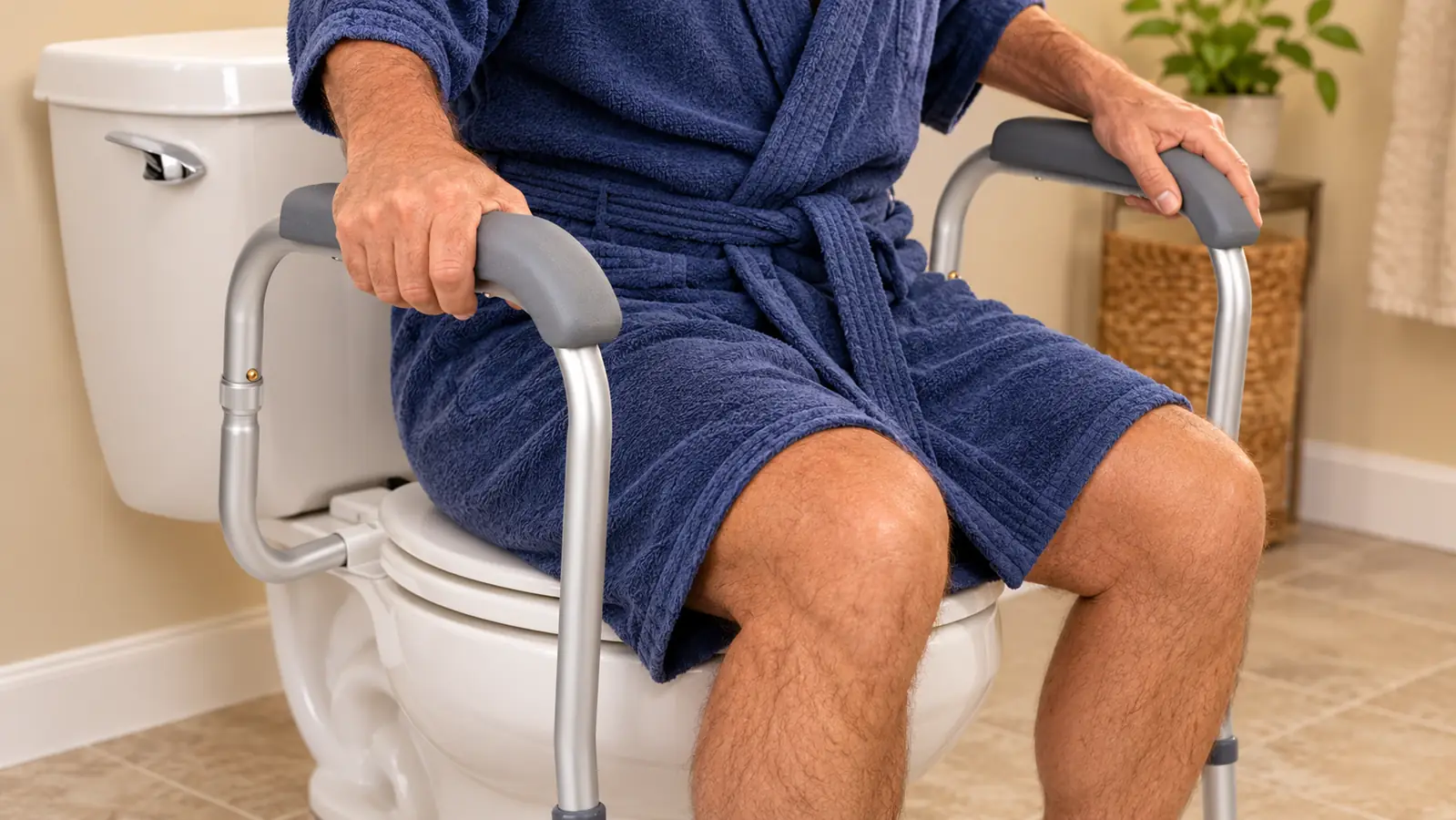
Step 2: Set the Width Out in the Hallway
The arm width adjusts, and that adjustment is much easier standing in a hallway than wedged between a tub and a vanity. Set it a touch wider than your hips, then carry it in. On mine that meant laying the frame upside down on a towel at the kitchen table and working the two sides out a notch at a time until the gap matched my hips plus a hand width. You will almost certainly move it again once it is around the bowl, and that is normal. The point is to start in the neighborhood.
The handles rotating back matters more than it sounds. Rotated back, the arms sit further behind you, which suits a person pushing up out of a seated position. Rotated forward, they sit closer to your knees, which suits a person who wants something to pull against on the way down. My physical therapist had me try both in her office before I picked one, and I would suggest the same if you have somebody doing transfer or gait work with you. That is a fitting question, and it is worth the phone call.
Step 3: Put the Arms Where Your Hands Actually Land
This is the step most people get wrong, and I got it wrong the first time. Sit down on the toilet the way you normally sit. Then stand up the way you normally stand, and pay attention to where your hands go. Not where you think they should go. Where they land when you are not thinking about it. My right hand goes out and slightly forward, roughly level with my hip when seated. Joan's goes higher and closer in. Same bathroom, same rail, two different settings.
Set the arms where your hands land, then sit and stand three more times to check it. The first fitting I did, I set the arms where the picture on the box showed them and spent a solid week reaching. Nothing dramatic, no fall, just reaching, which is its own kind of tired by Thursday. The second fitting, at my daughter's house, took four minutes because I did it this way from the start. Her guest bath ended up at 31 inches, two above mine, and she is four inches shorter than I am. That tells you the number has nothing to do with how tall a person is and everything to do with where their hands go.
One more thing about this step. Do it wearing whatever is actually on your feet at two in the morning. Slippers, stocking feet, an old pair of loafers, it does not matter, as long as it is the real thing. I did my first fit in work boots on a Saturday and then found out Sunday that the whole geometry shifted a half inch in stocking feet. It was a two minute fix and it annoyed me for a week that I had not thought of it.

Step 4: Set It in Place and Check the Tank, the Door, and the Fold
Set the frame around the bowl and sight down both sides. It should look even. If one arm is closer to the tank than the other, it is not square, and it will feel wrong every time you use it even if you cannot say why.
Then fold it once and unfold it before you trust it. The rail folds for storage and travel, and at 4.4 pounds it is easy to carry between bathrooms or stand in a closet when the grandkids visit. Mine rides in the trunk of the sedan when I take it to my daughter's, and it does not have to move anything else out of the way to fit. You want to know how the fold feels when it is right, so that if it ever feels different you notice. Last, read the weight rating honestly. The listing says 250 pounds in the title and 300 in one of the attribute fields. Trust the smaller number. If you are near it, or if you and a helper are both leaning on the thing at once, that is a conversation for your physical therapist and not something to guess at.
Step 5: Test It at 2 A.M.
Come back that night with the overhead light off and only the hall light on, and use the bathroom the way you actually will at two in the morning. Sit. Stand. Sit again. The rail is a piece of geometry and it does not care what time it is, but your balance at two in the morning is not your balance at ten, and the half-asleep version of you is the whole reason you are doing this. The first night I had mine, I came in at a quarter past two, sat down without turning on the light, and put my right hand out on the way back up. It landed where it was supposed to. That is the whole test, and it takes ninety seconds.
Then check the things nobody thinks to check. Does the arm catch your elbow when you reach for paper. Does the frame fight the shower curtain. Can the trash can still go where you want it. Is there a spot to set your glasses. All of it is a five minute fix now and a month of low-grade annoyance later.
Three fittings, three bathrooms. The only number I ever changed was arm height: 29 inches at my house, 31 at my daughter's.
What Else Helps
A rail is one piece of a bathroom that works. It is not the whole thing, and I would rather tell you that than sell you a story.
Light first. A plug-in nightlight by the door does more for a two in the morning trip than any single piece of equipment in my house, and it costs less than anything else in that room. I have two, one by the door and one over the vanity, because the overhead light is too bright at that hour and I quit turning it on months ago. Second, grab bars, if you can get them anchored into studs. A rail around the toilet helps you sit and stand. It does nothing for getting in and out of a tub-shower combo, and that is where a lot of falls actually happen. If you are putting in a bar, have somebody qualified anchor it into framing, not drywall. I have pulled enough drywall anchors out of walls to know what holds and what does not.
A raised seat is a different tool for a different problem. If your trouble is the distance down to the seat, a raised seat changes the distance. If your trouble is balance, the rail changes what you have to hold. Some people need both, and that is a real answer, not a sales dodge. Ask your physical therapist which one matches what they see when you stand up.
Keep the floor dry, keep a towel within reach, and tell your doctor and your physical therapist what you are using. I am a retired machinist with a tape measure. I can tell you how a frame fits and what I check before I trust it. I cannot tell you what your knees need, and anybody who says otherwise over a product page is selling something other than a rail.
Measure once, set the arms where your hands land, and retire the towel bar
Medline Toilet Handle Safety Rail: 27.5 to 32 inch height range, adjustable arm width, handles that rotate back, folds to 4.4 pounds, rated to 250 pounds. Today's price is on the listing.
Amazon Check Today's Price on Amazon →