

I walk a little over a mile most mornings now. Six months ago I could not get to the end of my own street without stopping twice and leaning on a mailbox. I have arthritis in both knees and a lower back that stiffens after about ten minutes of standing, and the fall I took in my garage left me bruised and a good deal more careful about where I put my feet. What got me walking again was not a pill and it was not willpower. It was a Drive Medical rollator with a seat and five habits I had to learn by doing them wrong first.
Before that I tried the things most people try. A cane helped my balance and did nothing about the weight coming down through my knees. A plain walker kept me upright but made me lift it and set it back down with every single step, which is its own kind of work. What I needed was something I could hold onto and keep moving behind. That is what a four wheel rollator is, and the one I settled on is the Drive Medical rollator with a seat, a fold up backrest, and 7.5 inch wheels. This is not medical advice. My physical therapist looked at how I walk and set the handle height for me, and yours should do the same. But between appointments there is a practical side to covering more ground that nobody bothers to write down, so here it is, in the order I would do it again.
The Walker I Lean On Every Morning
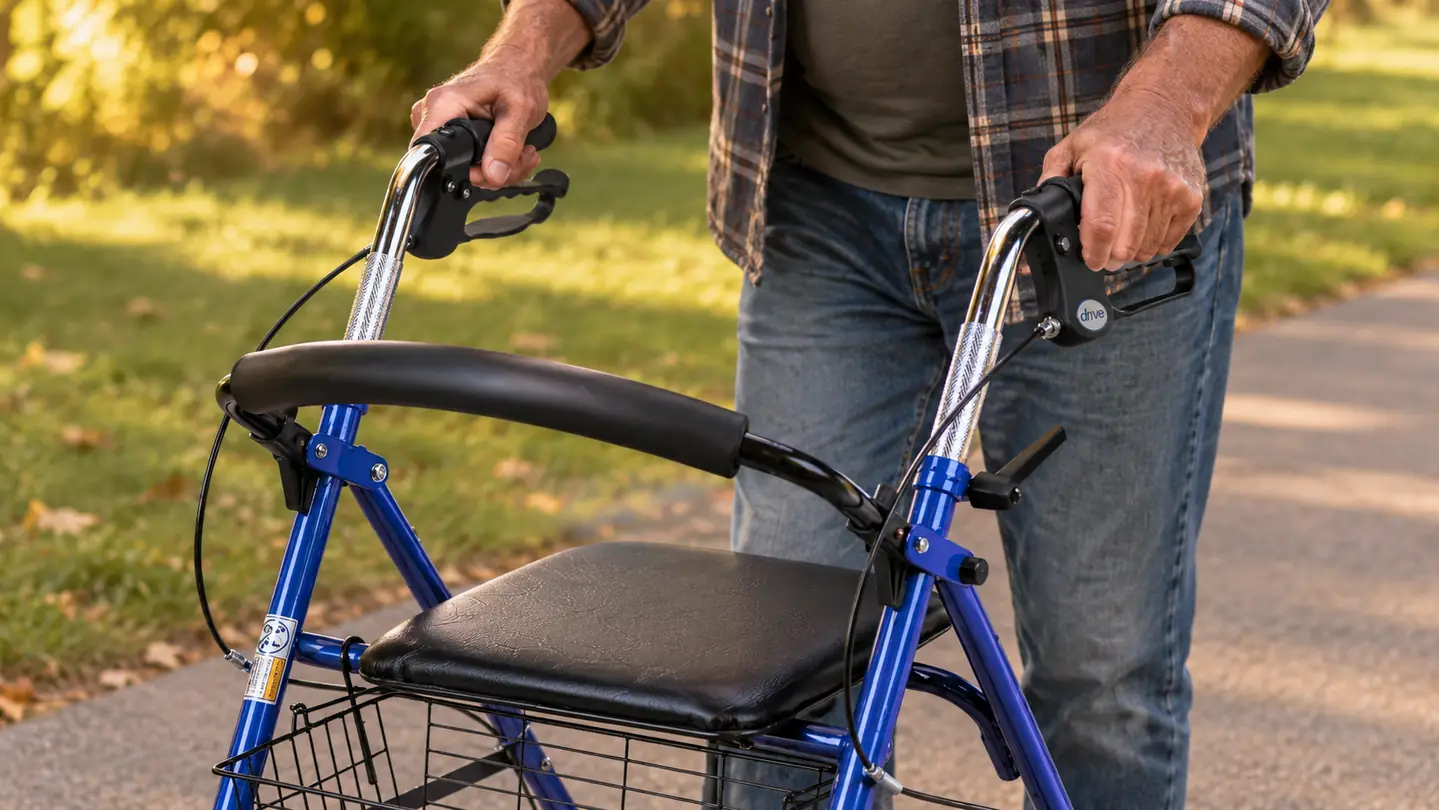
Four wheels, a seat, and a backrest that folds up and comes off. It weighs 20 pounds and holds up to 350 pounds. Mine has been on a sidewalk in every kind of weather and it still rolls straight.
Amazon Check Today's Price on Amazon →Five Steps That Got Me From One Mailbox to One Mile
Step 1: Set the Handle Height Before You Walk a Single Block
The height adjustment lever is the most important part of the whole machine, and it is the part most people set once and never touch again. Here is the rough rule my physical therapist used. Stand up straight with your arms hanging at your sides, and the grips should land about where your wrist creases. If you have to reach down, or if you have to lift your shoulders to hold on, it is set wrong.
I set mine too high the first week because it felt like more support. It was not. It made me hunch forward and it made my shoulders ache by the end of the street. The Drive Medical frame goes up to 35 inches at the top, and the manufacturer lists a minimum user height of 59 inches, so most adults have room to get it right. Set it, walk one block, and adjust again if your neck is complaining.
Get a second set of eyes on it. I had Joan watch me from the porch and tell me whether I was standing up or leaning. I was leaning. I could not feel it from the inside. Somebody standing ten feet away can see it in about four seconds.
Step 2: Walk Behind It, Not Beside It
A rollator is not a shopping cart. You do not push it out ahead of you with straight arms and you do not lean your weight forward onto it. You stand behind it, both hands on the grips, and you walk with your normal stride while it rolls along in front of your feet.
The first week I caught myself doing the shopping cart lean, especially going up the slight rise at the corner. It feels faster. It also puts your weight out in front of your feet, which is exactly where you do not want it if something catches. Keep your hips under you and let the 7.5 inch wheels do the rolling. They clear sidewalk cracks and the lip where the sidewalk meets the street without stopping dead the way small wheels do.
I also quit steering with my shoulders. The Drive Medical frame is alloy steel and it goes where the front wheels go, so if you want it to turn, turn the whole thing with your hands and your hips together. Yanking one grip sideways on a brick sidewalk is how you get a wobble you did not ask for.
The seat and the fold up back support are for stopping. They are not for scooting along. I have watched people sit and paddle themselves down the block with their feet, and it looks exhausting and unsteady at the same time. Sit down, rest, stand up, walk.
Step 3: Add Distance in Houses, Not Miles
The mistake I made was deciding I would go to the end of the street and back on day one. I made it, and then I was useless for two days, and I nearly quit on the whole idea. Distance builds the way anything builds, in small increments that feel almost too easy at the time.
Pick a landmark you can see from your own front door. Mine was the third mailbox. Walk to it, turn around, go home. Do that for a week. Then the fourth mailbox. Then the corner. Write it on the calendar in the kitchen, because you will not remember and you will argue with yourself about whether you are actually improving.
When you turn around, turn around while you are still feeling good. The walk back is not shorter because you are tired. Save a third of your energy for the return trip and you will not end up standing in somebody's yard trying to decide whether to sit on the seat or call your daughter.
Step 4: Change the Ground Before You Change the Goal
If the same loop is getting easier and you want more, look at where you are walking before you look at how far. My first route was all sidewalk, which is fine, and it was also all in full afternoon sun. Moving that same distance into the morning shade took ten minutes off how worn out I felt at the end of it.
Four wheels handle a sidewalk, a paved path, and the vinyl plank in my kitchen. They do not handle loose gravel, wet leaves, or the rough shoulder of a county road, and no rollator does. If the only walking you have nearby is a rough shoulder, find a school track or a mall before you go looking for a different rollator.
Watch the transitions, too. The two steps up onto my front porch are not something I do with the rollator. I leave it at the bottom and use the handrail. The same goes for the strip of carpet at the bedroom door. Carpet is not a problem for the wheels, but the seam where the carpet tack strip sits proud of the floor will stop you if you hit it at an angle. Take it square on.
Knowing which surfaces are rollator surfaces and which ones are not is most of the safety question. It is also most of the reason I kept going. A route you trust is a route you will walk again tomorrow.
Step 5: Sit Down Before You Need To
The seat is not a flag that says you failed at walking. I sat on it four separate times the first week. Now I sit once, at the turnaround, mostly because I want to and partly because the back support is genuinely comfortable.
The rule I follow is simple. If I am thinking about whether I could use a sit down, I sit down. The wobble comes on faster than you expect, and it usually comes on the way back when you are farthest from the house and the kitchen chair.
Sitting is also how you get to go farther. A rest of three or four minutes at the halfway point is what let me add the second half mile. Without the seat, that mile was not available to me. With it, the mile was just a walk with a break in the middle.
I sat on that seat four times the first week. Now I sit once, at the turn, because I want to and not because my knees have quit on me.
What Else Helps
Shoes matter more than I expected. A flat, closed shoe with the laces actually tied beats a slip on every time. I wore a pair of soft slip ons for the first two weeks and my feet slid forward inside them on every downhill stretch.
Keep your phone in your pocket, not in your hand. You need both hands on the grips and you are not going to catch yourself with a phone in your palm. If you walk alone, tell somebody which direction you went and when you expect to be back. Joan and I have a deal. I text her at the turnaround.
Strength work is the part people skip. My physical therapist gave me four exercises for the muscles around my knees. They are dull, they take eleven minutes, and they are the reason the walking got easier instead of just longer. Ask for them and do them on the days you do not walk.
And walk with somebody when you can. Joan comes with me on Saturdays. I walk slower when she is there and I enjoy it more, and that is a fair trade as far as I am concerned.
What to Check Before You Buy One
Weight. This one is 20 pounds. That is light enough to push all morning and heavy enough that getting it into the trunk of a sedan takes a plan. Lift it once in the store or in your own hallway before you decide, and lift it the way you would actually lift it, not the way you would lift it for an audience.
Width and depth. The Drive Medical spec sheet lists 21.5 inches wide and 25.5 inches deep. Take a tape measure to the narrow spots in your house first: the bathroom door, the gap between the kitchen counter and the wall, the path from the bedroom to the front room. Ours fits everywhere except the hall bathroom, and I knew that going in.
Capacity and warranty. It holds up to 350 pounds and carries a limited lifetime warranty on the alloy steel frame. A man I worked with for thirty years was a big man, well over 250, and he went through two cheap walkers in a year before he stopped buying on the sale tag. Buy for the capacity.
And check the back support. This one folds up and comes off, which matters if you want to stow it or if the backrest is in your way when you sit. I leave mine on. You might not.

Who This Is For
This is for somebody who can stand and walk but cannot do it as far or as long as they used to, and who would like some of that distance back. It is for the person who has been quietly shrinking their world down to the length of the front walk without ever deciding to. It is also for the adult child doing the shopping, the one trying to work out what to put in the trunk of the car before the next visit.
If that sounds like you, the order of operations matters more than the machine. Set the height, walk one short loop behind it instead of leaning on it, add a landmark at a time, change the ground before you change the distance, and sit down early and often. That is the whole method. It took me six months to work out and about three weeks to actually do.
Who Should Skip It
If your balance is poor enough that you cannot stand unsupported, a rollator is the wrong tool and you should be talking to your doctor about a different one. If your hands cannot grip and hold on, same answer. If you need to sit and push yourself along, that is a wheelchair question and not a rollator question. None of that is a judgment about anybody. It is just the wrong tool for the job, and the wrong tool is worse than no tool at all.
Start With the Same Walker I Use Every Morning
Twenty pounds, 350 pound capacity, a seat, and a backrest that folds up and comes off, with a limited lifetime warranty on the frame. Set the handle height before your first walk and give yourself a week of short loops before you decide how far you can go.
Amazon Check Today's Price on Amazon →