

The part nobody tells you about buying a rollator is that the machine is the easy part. The hard part is the Tuesday afternoon you stand in your own garage holding onto the workbench because your right knee folded without asking and did not straighten for a good ten seconds. That happened to me last spring. Nothing broke, but I bruised my hip and my pride. A Drive Medical rollator has been parked beside my recliner ever since, and I have put enough miles on it to tell you the parts the product page leaves out.
I am 71, a retired machinist, and I have arthritis in both knees plus a lower back that locks up after twenty minutes in a chair. My wife Joan keeps the shopping list and tells me when I am being stubborn. My physical therapist is the one who watched me walk and set the handles where they belong. I chose this Drive Medical four wheel rollator myself and I have used it daily since. What follows is the honest version.
The Quick Verdict
Twenty pounds of steel rated to 350 pounds, with a limited lifetime warranty and a seat worth resting on. It is stable and easy to live with, and the small hard wheels are the compromise.
Amazon Check Today's Price →Steel, a seat, and a warranty that actually means something. Here is the current listing.
Rated to 350 pounds with a limited lifetime warranty. Check the height range and the weight against your own numbers before you decide.
Amazon Check Today's Price on Amazon →How I Have Actually Used It
Most days it lives in the house. The kitchen floor is vinyl plank and the bedrooms are carpet, and the 7.5 inch wheels roll across both without digging in or bogging down. I use it to carry a cup of coffee from the counter to the table, which sounds like a small thing until you remember that carrying anything while leaning on a cane is a two trip job. On trash day I take it out the front door and down to the road. There are two steps up at my porch and I do not take the rollator down them. I carry it down and set it at the bottom. That is not a knock on the rollator, it is just how steps work.
I have also used it in a grocery store, on a sidewalk, and across the gravel lot at the co-op. Smooth concrete is where it is happiest. Gravel is where you find out that small hard wheels and loose rock are not friends. It did not tip on me, but I had to slow down and pay attention. If your balance is worse than mine, treat gravel as a place to be careful rather than a place to test your luck.
One thing I did not expect is how much the rollator changes a trip into town. I used to skip the far end of the store. Now I walk it, because I know there is a seat behind me if the knee starts up. That is a small change in habit and a large change in a day. It does not make me walk better. It makes me willing to walk further, which is a different thing and just as useful.
It came folded in a box with the back support off to the side. I opened the frame, set the height, and had it standing in about twenty minutes, most of which was spent hunting for the right wrench. There is one moment where the frame wants to close on your fingers while you line everything up, so keep your hands clear. If you are not handy, have whoever helps you around the house do it. It is not difficult, but it is a two hand job and it goes better with a second person holding the frame.
The Frame Is the Reason to Buy It
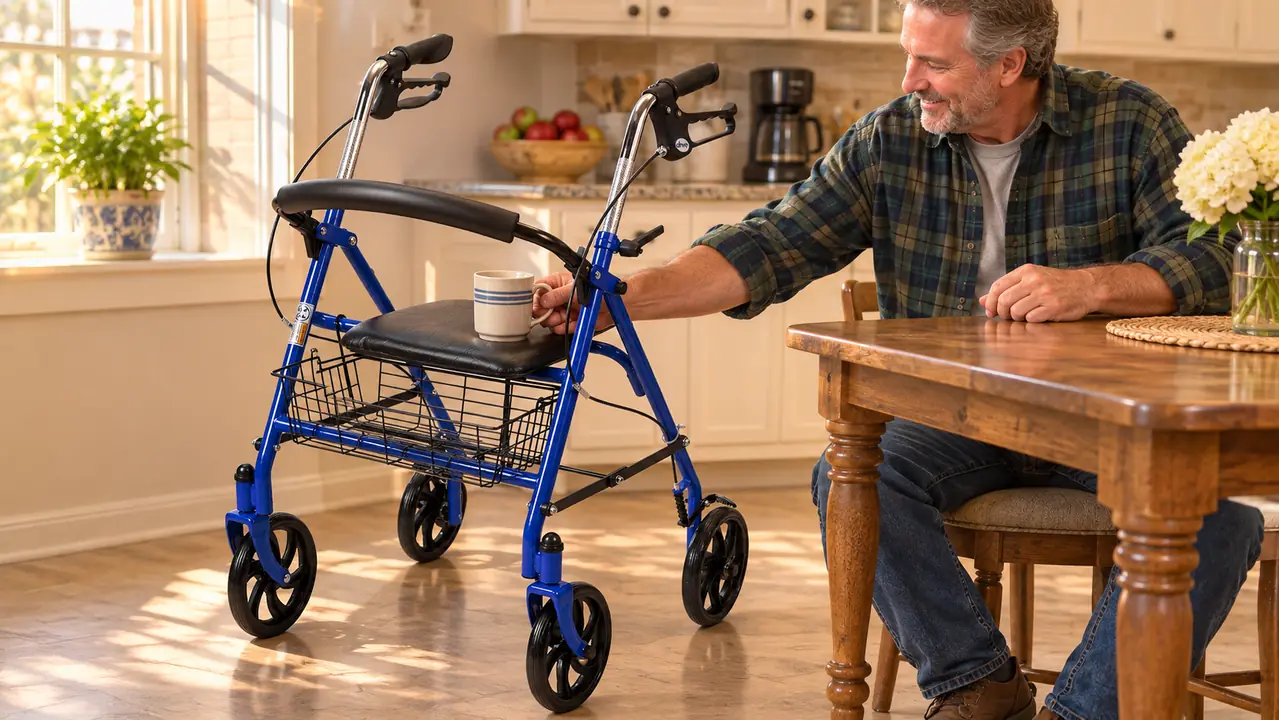
The material is alloy steel and the listing rates it to 350 pounds. I am 218 pounds and I have leaned on it hard, including the afternoon my knee went out in the kitchen and I put my whole weight through the handles without thinking. It did not flex. It did not creak. It did not slide away from me. That is the main thing I was after. A lot of the rollators sitting by the pharmacy counter are lighter metal and they feel like a lawn chair the moment you lean on them. This one feels like a piece of equipment.
It also carries a limited lifetime warranty, which is more than the pharmacy brands offer and more than I expected at this level. I have not had to use it. What I will say is that steel stays steel. I have gone around my frame twice with the tools in my garage and snugged things back down, and it has held its shape and its settings. If you are the sort who would rather keep something tight than replace it, that matters.
I have had it out in light rain twice and it did nothing dramatic, though the seat pad stayed damp for a while afterward. I would not leave it on a porch overnight. Steel and weather are not a partnership, and even with whatever coating is on the frame, I wipe mine down when it comes in wet. That is five seconds of work and it is cheaper than buying another one.
The tradeoff for the steel is weight. The listing puts the rollator at 20 pounds. Twenty pounds does not sound like much until you are lifting it into a trunk with a bad back. I can do it, and I do it in one motion, grabbing the frame at the middle and swinging it in. If my shoulder were worse than my knees, I would be shopping for something lighter and I would give up the warranty to get it. That is the honest trade.
Before this I used a cane, and a cane and a rollator are not the same tool. A cane gives you one point of contact and nowhere to rest. A rollator gives you two handles, four wheels and a seat, and you trade width and weight for that. I also borrowed a friend's aluminum rollator for an afternoon to see. It was lighter and easier to carry. It also felt like it wanted to fold up under me when I leaned on it. I am not saying aluminum is bad. I am saying that at my weight I want steel.
The Seat Is for Resting, Not for Sitting
Here is what the photographs do not tell you. The seat is a flat padded bench between the handles, and the back support is a small pad on a bar that folds up and can come off entirely. Both are genuinely useful. I have sat on that seat in the grocery line when my knee started talking. I have sat on it at the end of the road, waiting on Joan to bring the car around. What it is not is a recliner. There are no armrests, and the back pad sits low against your hips rather than behind your shoulders. Ten minutes is comfortable. Twenty is a stretch.
Two things about the seat matter more than they sound. The first is that the seat height is whatever you set the handles to, so if you set the frame tall for walking, the seat is tall and getting down onto it takes more leg than you might have. Set it, then try it before you trust it. The second is that you should not plan to sit and then push yourself up with nothing in front of you. I use the handles. If your grip is poor, ask your physical therapist whether a seat rollator is the right choice at all, because that is a question about you and not about the product.
Folding, Width, and Living With It
Folding takes two hands. You lift the seat and the frame closes up into a fairly flat package. That package is what goes in the trunk of my sedan, and it fits with room for groceries on top. What it does not do is fold one handed while you are holding a door open, and it does not stand up on its own once it is closed. You will be laying it down or leaning it against something. In a garage that is nothing. In a restaurant entry it is mildly awkward.
The width is the other number to know. The listing gives the footprint as 25.5 inches deep by 21.5 inches wide by 34 inches tall. That width decides whether you can take it through a doorway and down a hall with a laundry basket in the way. My hall bathroom is small and the rollator waits outside the door, which is fine, but measure your door opening before you order. This is not a narrow rollator. If your house was built tight, that matters.
Inside the house it is a better tool than I expected. It rolls across the bedroom carpet without fighting me, which surprised me given the wheel size. It turns cleanly in the kitchen. It does not turn well in my hallway, because the hallway is narrow and the rollator is 21.5 inches wide, so I end up backing out. That is geometry and not a defect. It is worth knowing before you buy one for a narrow house.

Setting the Height, and Why It Matters More Than You Think
The frame adjusts with a lever, and the listing gives a maximum height of 35 inches with a minimum height recommendation of 59 inches for the user. I am a shade over six feet and I run mine near the top. The number that matters is not on the sheet, though. It is where the handles end up when your arms hang, and they should land near the crease of your wrist. Mine did not, out of the box. My physical therapist moved them up two notches and the difference in my lower back after a lap around the block was not subtle. Set it standing, in your shoes, not sitting.
The lever has held its setting and has not slipped under me. It is still worth checking that it is fully seated every few weeks, because a rollator that drops a notch with your weight on it is a bad afternoon. That check takes two seconds and it is the sort of thing I do out of habit from thirty years in a shop.
Where It Let Me Down
Now the flaws, since that is why you are here. The wheels are small at 7.5 inches and they are hard. On a sidewalk with a raised seam, the rollator stops and you keep going for half a step before you catch up to it. I have learned to tip the front up at seams. I should not have to learn that. It is not dangerous if you are paying attention. It is unpleasant if you are not.
The seat pad is thin enough that I would not plan a long rest on it, and the back support bar rattles a little against the frame when it is folded down on rough pavement. I put a strip of tape on mine and the rattle stopped. You will hear it in a quiet store before you fix it. And there is nowhere built in to put a cup or a phone. I have seen people add a basket to the frame and that works, but it is another thing to buy and another thing to knock into a doorframe.
None of those are deal breakers. They are the difference between a good tool and a perfect one, and I have not met the perfect one. Add it up and you get this. The Drive Medical rollator is a stable, heavy, repairable piece of equipment with a seat that earns its place and a warranty that means something, and it will annoy you in small ways for as long as you own it.
What I Liked
- Alloy steel frame rated to 350 pounds, and it does not flex when you put your weight through the handles
- Limited lifetime warranty, which is rare at this end of the market
- Seat and fold up back support are useful for resting mid trip
- 7.5 inch wheels roll cleanly on carpet, vinyl and smooth concrete
- Height lever holds its setting, with a 35 inch maximum
Where It Falls Short
- 20 pounds is real weight to lift into a trunk with a bad back
- Small hard wheels catch on sidewalk seams and struggle on gravel
- Seat is a bench, not a chair, and there are no armrests
- Folding takes two hands and it will not stand on its own
- No built in spot for a cup or a phone
It did not flex, it did not creak, and it did not walk away from me. That is the whole reason I keep it.
Who This Is For
This is for someone heavy enough or unsteady enough that a flimsy frame is a real worry, and who wants a seat to rest on rather than a chair to sit in. It suits a one story house with carpet and hard floors, a car with a real trunk, and a routine that includes a grocery store and a sidewalk. It suits a person who does not mind going around the frame twice a year with a wrench. If that is you, this Drive Medical rollator will do the job for a long time.
Who Should Skip It
Skip it if you cannot lift 20 pounds, or if it is going in and out of a car several times a day. Skip it if you walk mostly on gravel, grass or broken pavement, where small hard wheels will fight you. Skip it if your bathroom door is narrow, because it is 21.5 inches wide and it is not going in. And skip it if you need arms on a chair to get yourself up, because this is not that chair. If you are unsure, have your physical therapist watch you walk before you order anything, and take their answer over mine.
I fell in my garage because I waited too long to use something. That is the plain truth of it. The rollator did not give me back my knees and it is not going to. What it gave me was a hand to hold on the way to the mailbox and a place to sit when the line at the pharmacy is long. If that is what you are after, this is a good one, and now you know the parts that will annoy you.
You have the flaws. Now check the numbers that matter for your own body.
Height range, weight rating, footprint and warranty. Measure your doorway and think about your back before you order.
Amazon Check Today's Price on Amazon →