

I put off buying a bed rail for eight months. Not because of the money. Because I had convinced myself that a 71-year-old retired machinist with arthritic knees ought to be able to get out of his own bed without hardware. So I did what stubborn men do. I rolled to the edge, pushed off the mattress with both palms, and hoped my right knee would hold. Most mornings it did. The morning it did not, I sat back down hard and knocked the lamp off the nightstand. That was the week I ordered a Medline bed assist bar. It was also the week I learned that the bar itself is maybe a third of the job. The other two thirds are where you put it and how you use it.
Before the bar, my exit routine was a list of bad ideas. Grab the nightstand and hope it does not tip. Pull on the headboard and hope it is bolted down. Drag the sheet sideways because it is the only thing within reach at six in the morning. None of those give you a fixed, known height to push against. That is the whole point of an assist bar. It does not lift you, and anybody selling it as a lift is selling you something else. What it does is give your arms a place to spend effort so your knees do not have to spend all of theirs. Getting that to work takes about an hour of setup and a week of practice. Here is the order I would do it in if I were starting over.
The bar that has been bolted to my bed frame for two years and has not budged
Height adjustable, a nylon storage pocket for glasses and the remote, and sized for non-articulating twin, full and queen beds. It weighs 6.4 pounds, so putting it in place is not a two-person job.
Amazon Check Today's Price on Amazon →Step 1: Measure Your Mattress Before You Order Anything
Get a tape measure and write two numbers on the back of an envelope. First, the distance from the floor to the top of your mattress. Second, the gap between the side of your mattress and whatever sits beside it, whether that is a nightstand, a dresser, or a wall. Those two numbers decide whether a bar will work in your room and where the handle will end up sitting relative to your hand. I measured mine on a Saturday morning and taped the envelope to the inside of the closet door, which is where it still is.
Then check what kind of bed you have. The Medline bar is built for non-articulating twin, full and queen beds. If you sleep on an adjustable base that raises the head or the foot, this is not the piece for that bed, and forcing it is how people bend hardware. You also want a mattress heavy enough to pin down the flat section of the bar. On a bare platform with a thin foam mattress and nothing above it, the bar will walk around on you. Measure, look at what is under the mattress, and then order.
If you are doing this for a parent in another house, measure their bed, not yours, and ask which side they get out of. I have watched two grown adults argue about that in a driveway for ten minutes, and the answer was the side nearest the bathroom the whole time.
Step 2: Slide the Flat Frame Under the Mattress and Pick Your Side
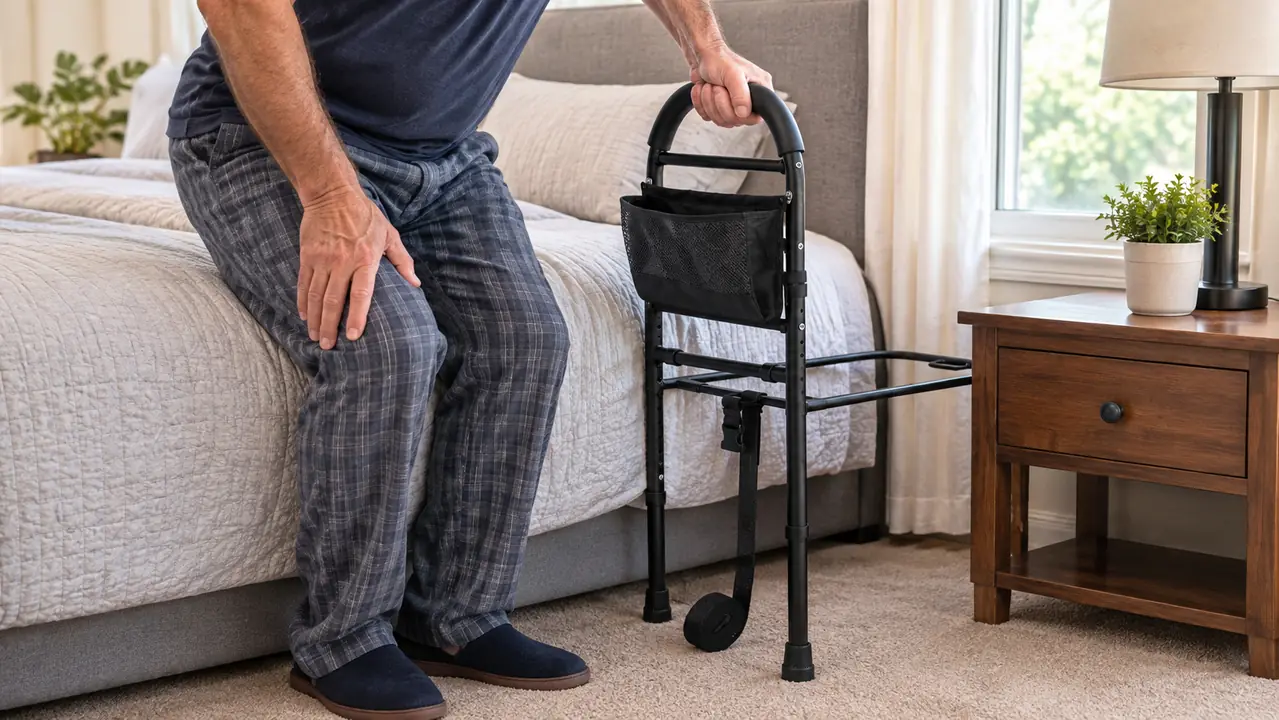
The bar goes in flat. Lift the corner of the mattress, slide the flat portion in between the mattress and the box spring, and set the handle on the side of the bed you actually get out of. For me that is the right side, because my right knee is the one that buckles. For you it may be whichever side is closer to the bathroom at two in the morning. Do not put it in the middle of the foot of the bed where you will bark your shin on it. At 6.4 pounds the whole thing is light enough that I set mine alone in about ten minutes, and I am not a flexible man.
Push it in far enough that a real length of the flat frame sits under the mattress weight, not just the last two inches. Then press down on the handle the way you will when you get up. If the frame rocks or lifts the mattress corner, it is not in far enough. Re-make the bed over the top of it. The nylon pocket wipes clean with a damp cloth, so do not baby it. Mine has collected a reading glasses case, a pen, and roughly four months of dust, and it has not torn.
Step 3: Set the Handle Height While You Are Sitting Down
The height is adjustable, and this is the step people skip. Do not set it standing up in the middle of the room. Sit on the edge of the bed the way you do in the morning, and put your hand on the handle. You want your elbow slightly bent and your hand landing on the grip without leaning down to find it. If you have to reach down past the mattress edge, the handle is too low and you will end up pulling rather than pushing. If it crowds your ribs when you roll over at night, it is too high.
Get it close, then tighten whatever holds the height and sit on it again. Check it a second time with your other hand, because most of us have one side that is stronger and one shoulder that complains. Then leave it alone for a week. After seven nights of real use you will know whether it needs to come up an inch. Check that the adjuster is still snug after that first week, and again after the first month. Mine needed a second tightening and has not moved since.
Step 4: Relearn the Sit-to-Stand Sequence, Not Just the Grip
This is the part that changed my mornings, and it has nothing to do with the hardware. Roll onto your side and bring your knees up toward your chest. Push your top arm against the mattress to sit yourself upright. Then scoot forward until your feet are flat on the floor and your heels are under your knees, not out in front of you like you are reclining in a chair. Feet tucked back is the difference between standing up and folding up.
Now the bar. Put the heel of your hand on the grip and push straight down. Down, not toward you. Pulling a bar toward your chest is how people yank a bed frame out of position and how shoulders get angry. Lean your nose out past your toes, push down through the handle, and stand. Then stop. Count two before you take a step, because the first step after sitting is where my knee has something to say, and standing still for two seconds lets it finish saying it.
My physical therapist walked me through that sequence after my fall in the garage, and she watched me do it wrong twice before it stuck. If you have one, ask yours to watch you get out of bed once. It takes five minutes and it is worth more than any instruction sheet. I am not going to tell you what is safe for your body. That is a question for your doctor or your therapist, not for a retired machinist with a tape measure.
Step 5: Fix the Rest of the Path, Not Just the Bed
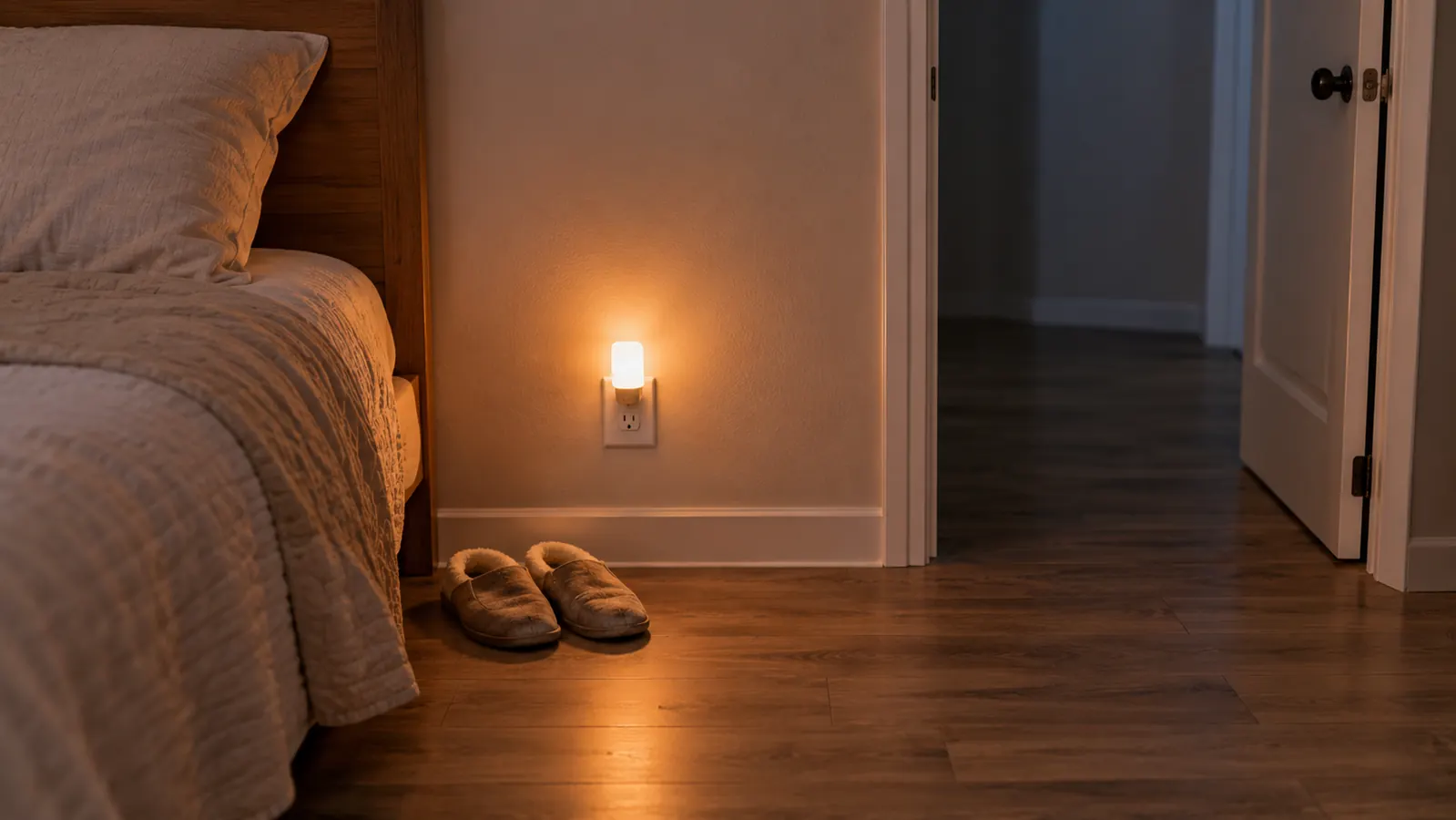
A good handhold at the mattress does not help much if the floor between the bed and the bathroom is a minefield. I put a plug-in night light low on the wall so it comes on before I am fully awake. I squared my slippers beside the bed so I am not hunting for them with a bare foot at three in the morning. I took up the throw rug that slid on the vinyl plank in the hall. Every one of those took less time than reading this paragraph, and every one of them has already paid for itself.
Use the storage pocket. Mine holds my glasses, a pen, and the television remote, which means I am not twisting around to the nightstand in the dark with one hand on a bar. Keep the floor lane clear. No laundry baskets parked at the foot of the bed, no shoes kicked into the walking path, no charging cord stretched across the carpet. If you get up twice a night, walk the route once in daylight and look at it like a stranger would. You will find two things you have been stepping over for a year.
What the Bar Does Not Do
It does not lift you out of bed. It does not replace a walking aid once you are upright, and it will not make a bad knee good. It is not a restraint and it is not designed to keep somebody from rolling out of bed, so if that is the problem you are solving, you are looking at the wrong category of equipment entirely. It is also not built for an adjustable bed that articulates. I would rather say that plainly than have somebody bend one trying to make it fit.
What it does is narrow and useful. It gives you one fixed point at a known height, on the side of the bed you actually use, so that standing up becomes a push instead of a lunge. That is a small thing until the morning your knee quits on you, and then it is the difference between sitting back down and going down.
What Else Helps
A lamp you can reach without getting up beats a ceiling light every time, and a lamp with a switch on the cord beats one you have to fumble for. I keep a phone charged on the nightstand, in the same spot, every night. Joan has made it clear that if I am going to insist on getting up in the dark, I am going to do it with a light on and a phone in my pocket, and she is right, which I say as rarely as I can manage.
Shoes matter more than people think. Bare feet on carpet are fine until they are not, and a firm-soled slipper with a closed back is a better walking surface than a loose scuff that slides off mid-step. That is a physical therapist question, and mine had opinions. The other thing that helps is having somebody check on the setup. My daughter looked at my bar on a weekend visit, pushed on it, and asked whether the frame was in far enough. It was not. I had been living with a bar that shifted a quarter inch every time I used it, and I had stopped noticing.
Two years in, the Medline bar has asked for exactly two things from me: a damp cloth now and then, and one tightening of the height adjuster. That is the whole maintenance report. The better measure is that I have stopped thinking about getting out of bed in the morning, which is what any of this gear is for. The hardware fades into the room and you just stand up.
The bar does not lift you. It gives your arms somewhere to spend effort so your knees do not have to spend all of it.
One fixed handhold, set at the height you actually reach for at six in the morning
Height adjustable, a nylon pocket for the glasses and the remote, and sized for non-articulating twin, full and queen beds. Set it up once, check the adjuster after a week, and then forget it is there until you need it.
Amazon Check Today's Price on Amazon →