

Six weeks after I fell in my garage, I finally figured out that my cane was set wrong. Not by a lot. An inch and a half, maybe two. That was enough to make my right wrist ache by suppertime and to send my shoulder creeping up toward my ear on every step. I had blamed the arthritis. It was the cane.
Here is what nobody tells you when they hand you a cane at the pharmacy counter. The height setting is the whole ballgame. Too short and you hunch forward, leading with your shoulder. Too long and your arm turns into a lever pushing up into your neck. Either way you are working harder than you need to, and if you are carrying a cane in the first place, you are already working hard enough. I use the HONEYBULL folding cane now, the one that adjusts from 30 inches to 36 inches, and I want to walk you through how I set it, because the range printed on the package is not the same thing as the setting your body needs.
I am not a therapist and I will not pretend to be one. I am a 71 year old retired machinist with arthritis in both knees and a right knee that buckles on stairs if I do not think about it. What follows is the procedure I use, checked against what my physical therapist showed me after the fall, and it takes about five minutes.
Get the height right once and you stop thinking about the cane
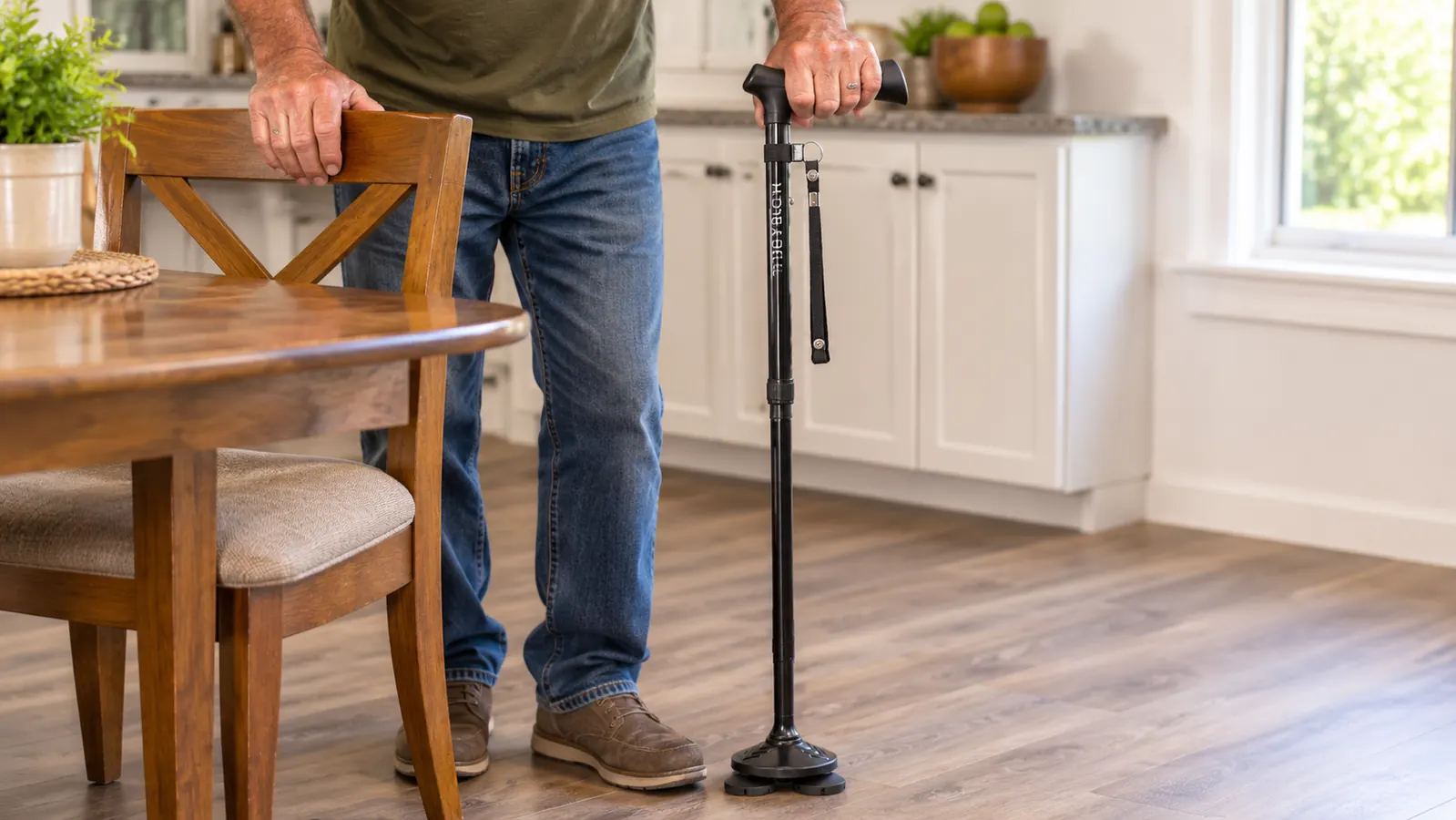
The HONEYBULL folding cane adjusts from 30 to 36 inches on a push button lock, and the extra wide three tipped base lets it stand on its own so you are not bending to pick it up off the kitchen floor.
Amazon Check Today's Price on Amazon →Step 1: Measure From the Floor to the Crease of Your Wrist
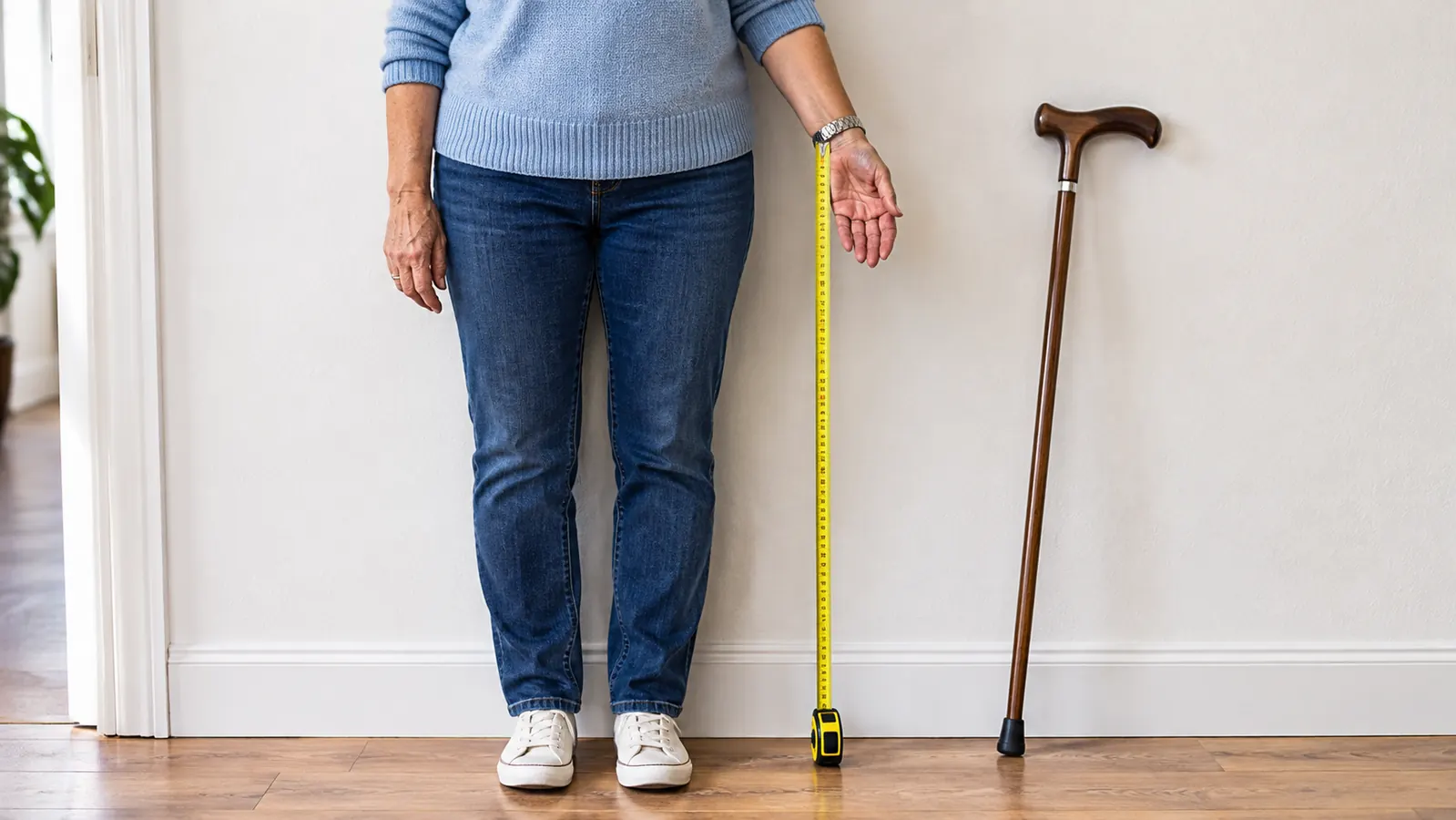
Put on the shoes you actually walk in. Not your slippers, and not your church shoes if you wear something else around the house. The shoes change the number, sometimes by most of an inch. Stand up straight, let the arm hang loose at your side, and find the crease where your hand bends back, the line right below the palm. The distance from the floor to that crease is your starting number.
For me that came out at 34 inches. I am about 5 foot 10 and I was wearing my everyday shoes with a firm sole. I wrote it on the back of a receipt and stuck it in my shirt pocket, because I have learned the hard way that I will not remember a number between the kitchen and the garage.
This is a rule of thumb and it is only that. My physical therapist checked my fit after the fall and adjusted how I stood, not just the number on the cane. If you have had a hip replaced, if one shoulder is noticeably weaker than the other, or if a therapist has worked with you before, ask them to look at your setup. I can tell you what worked on mine and what to check. I cannot tell you what your body needs.
Step 2: Set the Push Button and Make It Click
The HONEYBULL has a push button lock. You press the little button in, slide the lower shaft until you find the hole you want, and let the button pop back out through it. When it is set right you feel the click and the shaft will not slide. If it slides, it is not locked, and you need to try again rather than hope it holds.
Set it to the number you measured. Then, and this is the part I got wrong the first time, set it one hole up and one hole down and compare all three. The holes on a cane like this are about an inch apart, so you are choosing between three settings in your neighborhood. Do not settle for close enough. An inch is not a small thing at the end of a lever you lean on all day, and it is a lever, whether it feels like one or not.
The cane folds into three sections and comes down to about 12.5 inches, which is why mine lives in the pocket of my car door instead of the trunk. That also means when you unfold it you should glance down and make sure the button has fully seated before you put weight on it. I check every time. It takes a second and it costs nothing.
Step 3: Stand Up and Check Your Elbow
Stand with the cane planted a comfortable step ahead and to the side of your foot, grip the handle, and look at your elbow. On a well set cane the elbow keeps a soft bend, not locked straight and not folded up. Somewhere around 15 to 20 degrees is the usual guidance. Arm straight as a board means the cane is too long. Elbow bent sharp means it is too short.
The test that told me more than the angle did was this one. Grip the cane and take ten steps down the hallway. If your shoulder stays down and your neck stays loose, you are close. If your shoulder rides up, or if you catch yourself pushing the cane away from you instead of leaning on it, you are too long. If you feel like you are reaching for the floor, you are too short.
I walked my kitchen and hallway three times before I quit fiddling with it. The setting I landed on was 34 inches, which is what I measured, but I did not trust the tape measure until a walk confirmed it. Numbers lie when you are standing still. They tell the truth when you are moving.
Step 4: Look at the Base and What It Is Standing On
The HONEYBULL stands on a base with three tips, and the whole base is about 4 inches across. That width is what lets the cane stand up on its own, which sounds like a small thing until the first time you are carrying a coffee cup and a plate at the same time. It also puts three points of rubber on the floor instead of one, and that is steadier on the vinyl plank in my kitchen than the single tip cane I had before.
Check the tips for wear every couple of months. Rubber hardens and goes shiny, and a shiny tip on a wet porch step is not doing much for you. I keep a set of replacements in the kitchen drawer. Walk the cane across every surface you actually use. The carpet in my bedrooms grabs a little, the vinyl plank is slicker, and the two steps up to my front porch are the place I am most careful. That is where I test any change first.
If you are on the fence about a three tipped base, think about where your cane spends its day. Mine spends most of it leaning against whatever I set it against, and a cane that stays where you put it is a cane you do not have to chase across the room. That is most of the reason I switched, and it had nothing to do with the height at all.
Step 5: Recheck It Whenever Something Changes
The height you set in July is not necessarily the height you want in January. Shoes change, and a thick sole versus a thin one can be most of an inch. A knee that is more swollen in the morning than in the afternoon changes how you stand. If you have been sitting a while and you are stiff, you will lean on the cane differently for the first twenty steps, whether you mean to or not.
I check mine about once a month, and always after a long drive or a trip where it has been folded and unfolded a few dozen times. A folding cane takes more handling than a solid one, and handling is how you find out whether a button is still crisp or getting mushy. Mine is over two years old, still clicks like it did on day one, and the warranty is two years, which is longer than I expected.
There is one more thing worth checking, and it is the lock, not the height. Press the button, pull at the lower shaft, and make sure it will not budge until you press again. A cane that collapses under you is worse than no cane at all. Mine has never done it. I check anyway, because checking is free.
An inch and a half was the difference between my wrist aching by suppertime and me forgetting I was carrying a cane at all.
What Else Helps
Grip the handle in the hand opposite the side that needs the help. If your right knee is the bad one, the cane goes in your left hand and moves forward with your right foot. That feels wrong for about a week and then it stops feeling like anything at all. I fought it. My physical therapist won, and she was right.
The handle on the HONEYBULL is ambidextrous, so it does not matter which side you end up on. That mattered to me because I started on the right and moved to the left after the therapist watched me walk, and I did not have to go buy a second cane to do it.
Keep the cane where you can reach it from a seated position. The free standing base helps here more than I expected. I set mine beside the chair and it stays there instead of sliding down flat and making me bend for it, which is exactly the motion I am trying to avoid in the first place. And if you are carrying one around all day, weight matters. This one is 0.44 kilograms, about a pound, and I do not notice it in my hand.
One last note on the folding part. Three sections means three joints, and joints are where anything wears out. Keep them clean and dry, especially after rain or a salty sidewalk in winter. I wipe mine down with a rag when I think about it, which is not often, and it has held up fine.
When to Ask Someone Else to Look at It
If you are setting up a cane for a parent or a spouse rather than for yourself, do the measuring with them standing up, in the shoes they actually wear. I have watched adult children measure a cane against a seated parent and come out two inches short. Get them on their feet, hand them the tape, and let them hold still for thirty seconds.
And if anything about the fit feels wrong after a week of walking, call the doctor or the physical therapist instead of living with it. A cane that is off by an inch will not announce itself. It just quietly makes your shoulder and your wrist do work they were not meant to do, and you will blame your age for it the way I did for six weeks.
Set it once, check it monthly, forget about it
The HONEYBULL folding cane adjusts from 30 to 36 inches, locks on a push button, stands on its own 4 inch base, and folds down to 12.5 inches for the car door pocket. Measure your wrist crease first, then set it.
Amazon Check Today's Price on Amazon →