

I am Lyle Haverkamp, 71, a retired machinist outside Huntsville, Alabama. I have arthritis in both knees, a lower back that stiffens up, and a right knee that buckles when I stand after sitting a while. I took a fall in my garage that left me bruised but not broken, and that fall is what got me using a cane. The HONEYBULL folding cane has been in my house for a stretch of months. This is the honest version of what I think of it, including the parts I do not love.
I am not a doctor and I am not going to play one here. My family doctor and my physical therapist are the ones who checked my walking and set the height on this cane. What I can tell you is what a retired machinist notices: how a thing is built, where it binds, what rattles, and whether it holds up after the new wears off. The HONEYBULL is a good cane with a few quirks. I will give you both, and I will tell you who should look at something else.
I have used it on the porch, in the kitchen, through the bedroom carpet, in the hall bathroom, and across the parking lot at the grocery store. I have folded it and put it in the trunk of my mid-size sedan more times than I can count. I have not used it for hiking or on a trail, and I would not. That is not what it is for.
The Quick Verdict
A light, foldable cane that stands on its own and adjusts to a wide range of heights. The three-pronged base is steady on flat ground but noisy and wide in tight rooms, and the push button demands a habit of checking it.
Amazon Check Today's Price →The cane that stays where you set it down
The free-standing base is the reason I keep reaching for the HONEYBULL by the kitchen chair. Before you order, check the range against your own frame: 30 to 36 inches, built for people 5 feet to 6 feet 5 inches.
Amazon Check Today's Price on Amazon →How I've Used It
I use it mostly around the house and on the porch. My place is a one-story brick ranch with two steps up at the front door, carpet in the bedrooms, vinyl plank in the kitchen, and one small hall bathroom with a tub-shower combo. That mix of surfaces is a fair test for any cane, because carpet grabs, vinyl is slick, and a wet bathroom floor is no place to find out your base is not sitting flat.
I set the height inside the range the listing gives, 30 to 36 inches, and I check the push button before I put weight on it. The cane is listed at 0.44 kg, which is light enough that I can carry it in one hand while I hold the railing with the other. The aluminum shaft and the push button lock are the two things I notice most day to day. The button snaps into a hole and holds, but you have to be sure it is fully seated. I have caught myself once or twice in a hurry, and that is on me, not the cane.
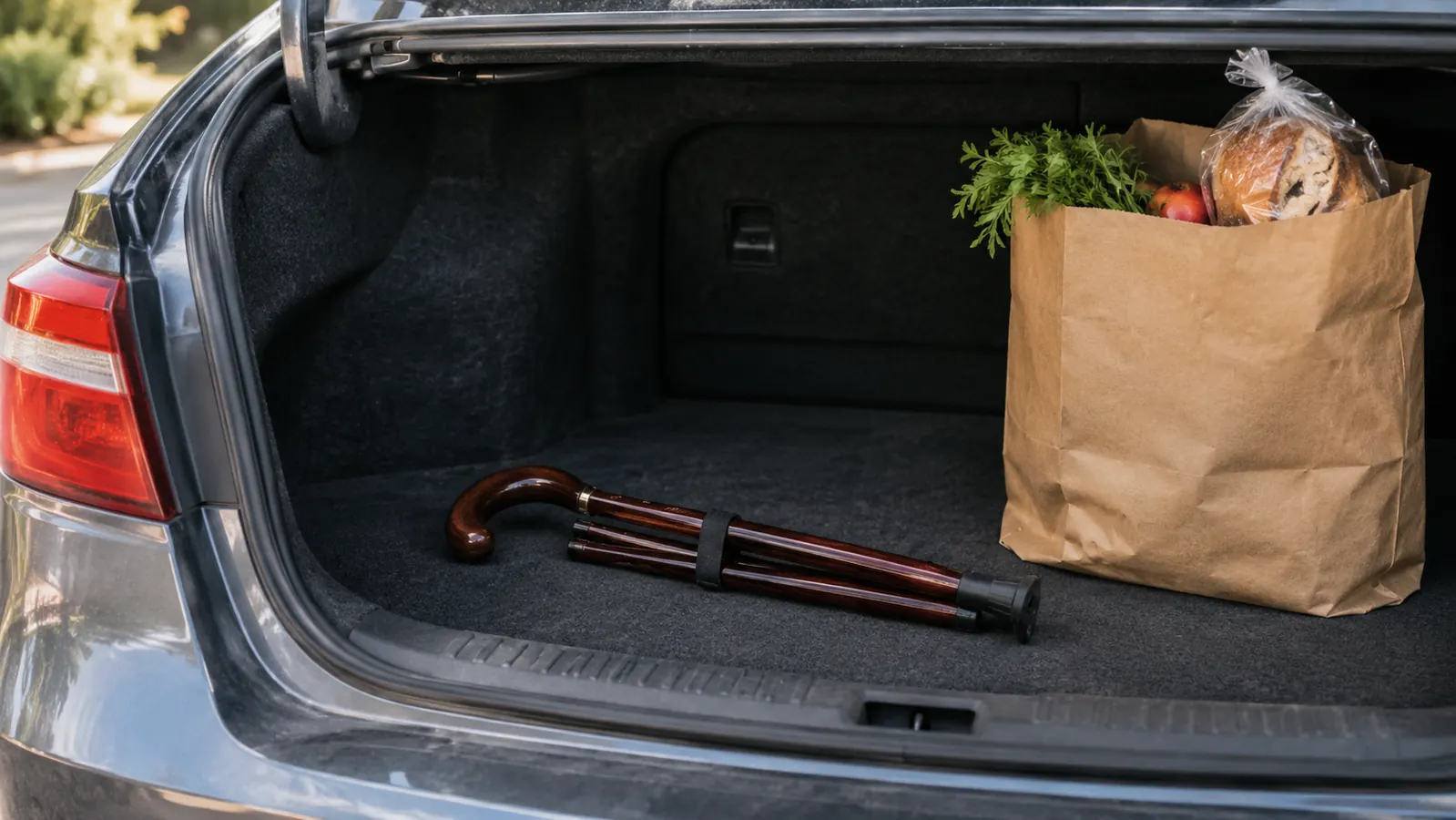
Out of the house, it folds to 12.5 inches, per the listing, and that fits in the trunk of my mid-size sedan without me having to wrestle it. I keep it folded on the passenger floorboard sometimes, and it does not take up much room. At the store I unfold it in the parking lot and set the base down flat before I lean on it. The three-pronged base is the whole reason I wanted this style: it stands on its own when I let go.
My physical therapist watched me walk with it and made one adjustment. She also told me to keep the base flat and to lift the cane rather than drag it over a threshold. That advice matters with this model. The base is 4 inches wide, and it will catch on a rug edge or the lip of a threshold if you come at it sideways.
The two steps up to my front porch are where I am most careful. I set the base flat on the concrete, take the railing with my free hand, and go up one step at a time. The cane is light enough to lift to the next step without swinging it. If you drag it up a step, the base catches. My physical therapist told me to lift and place, not drag, and that one instruction made the cane feel much more stable.
What the HONEYBULL Gets Right
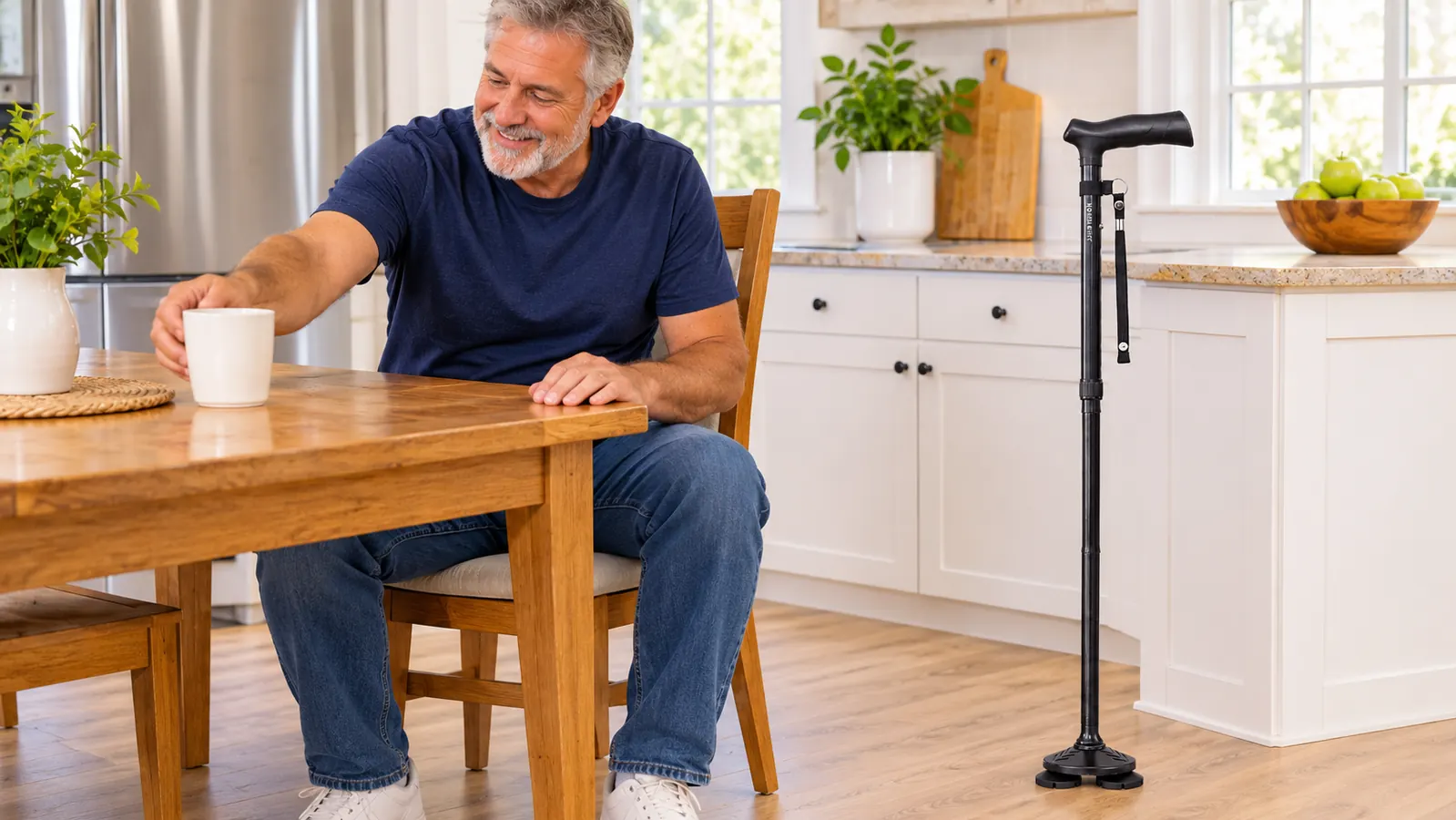
The best thing about the HONEYBULL is the free-standing base. I can set it beside my kitchen chair, let go, and it stays upright while I use both hands to move a mug or pick up the mail. A single-tip cane would be on the floor. The listing calls it a 3 tipped base on a 4 inch base, and that is accurate to what I see. On flat vinyl or concrete, it stands there like it has a mind to stay.
The height range is another practical point. The cane adjusts from 30 to 36 inches and the listing says it fits people 5 feet to 6 feet 5 inches. I set mine in the middle and left it there. The push button is easy to work with a thumb, and the hand orientation is ambidextrous, so it does not matter which hand you use. Joan is left-handed and she can use it without fuss when she carries it out to the car for me.
Weight matters more as you get older, and 0.44 kg is light. I can hook it over my arm while I unlock the door, or carry it up the porch steps without feeling like I am hauling a fence post. The aluminum frame has a 2 year warranty, which is not the longest I have seen, but it is not nothing. The listing gives dimensions of 8 inches wide by 36 inches high, an extended length of 37 inches, and a maximum height recommendation of 91.44 centimeters. Those numbers line up with what I measured with a tape in my shop.
The three-pronged base is also steadier on uneven concrete than a single tip. My driveway has a crack that has lifted one side, and the cane sits across it better than the old single-tip cane I borrowed from my neighbor. I am not saying it makes you fall-proof. No cane does. I am saying the base gives you a wider patch of contact, and I can feel the difference when I am standing still.
The 8 inch width and 36 inch height in the listing are close to what I measured. I am not a surveyor, but I know a tape measure. The base footprint is the part that matters in a hallway. It is wider than a single tip, and that is the trade: more stability when standing, less clearance when turning.
What Nobody Tells You Before You Buy
Here is the part I would want to know. The free-standing trick works best on a hard, flat surface. On the carpet in my bedrooms, the base does not slide, which is good, but it also does not settle as cleanly when I set it down. I find myself lifting it and placing it rather than just dropping it. On the vinyl plank in the kitchen, it stands fine, but the three tips make a tapping sound that Joan can hear from the other room.
The base is wider than a single tip, and that cuts both ways. In my small hall bathroom, the 4 inch base bumped the door frame when I turned around. I had to learn to pick it up and turn it rather than pivot it on the floor. If your bathroom is tight, walk it through the space before you decide. The same goes for a crowded restaurant or a doctor's waiting room with chairs close together.
The folding joint is handy, but it is still a joint. After a few months of daily use, mine has a little more play in it than it did when it came out of the box. It has not failed, and I do not think it will, but I check it. I open it fully, push the button until it clicks, and give it a tug before I lean on it. If you are the kind of person who unfolds a cane and just goes, you need to slow down for the first week until it becomes a habit.
The box contains the cane and a manual. That is what the listing says under included components, and that is what I got. There is no strap and no carrying bag. For the trunk of a sedan, that is fine. If you want to hang it on a hook or carry it on a bus, you will want to add your own strap or look at a different model. That is a small thing, but small things are what you notice after the return window closes.
The top of the height range is worth a hard look. The cane adjusts to 36 inches and the listing says it fits people up to 6 feet 5 inches. I am not that tall, so I cannot speak for the far end of that range. If you are near the top, have someone measure you and check the fit with your physical therapist before you order. A cane that is too short will have you hunched, and one that is too tall will have you reaching. Neither is good for a sore back.
One more thing nobody puts on the box: the cane attracts attention. People see a three-pronged base and ask if you had surgery. That is not the cane's fault. It is just what happens. If you are a private person, a plain single-tip cane draws less comment. If you want the thing to stand on its own, you accept the questions.
The free-standing base is the reason I kept it: I can set it beside the kitchen chair, let go, and it stays put while I use both hands. That one feature is worth more to me than the folding joint.
How It Has Held Up
I have used the HONEYBULL on vinyl, carpet, concrete, asphalt, and the tile floor at the grocery store. The aluminum shafts have a few scuffs from the car trunk and the porch, which I expect. The push button still snaps and holds. The base has not cracked or worn through. I check the tips every couple of weeks for grit and wear, the same way I check the air in my tires. That is not a special maintenance schedule. It is just what you do with a tool you lean your weight on.
The one thing I would change is the base for indoor use. I would like a quieter version for the house, or a way to swap the three tips for something softer on hard floors. The listing does not offer that, so I live with the tap. I also would like a strap in the box, because I have dropped it once getting out of the car. Those are small complaints. They do not make it a bad cane. They are the reasons I am not giving it a top score.
I have not had a failure. I have had a few moments where I did not get the button fully seated and the cane slid down an inch. That will get your attention. Now I check it every time, the same way I check a chuck on a drill press. If you are not in the habit of checking, set a reminder for the first week. It becomes second nature.
What I Would Change
If I could make one change, I would put a strap in the box. It is a cheap addition and it would save a lot of bending over. The second change would be a quieter base for indoor floors. The three-pronged base is what makes the cane stand on its own, so I do not want to lose that. I just want a version that does not sound like a tap shoe in my kitchen.
I would also print the height range in plain language on the outside of the box. The listing is clear enough, but a lot of people buy a cane in a hurry after a fall or a surgery. A simple chart that says 30 to 36 inches and fits 5 feet to 6 feet 5 inches would help. That is not a knock on the cane itself. It is a knock on how the information is presented.
I would also make the folded length a little more obvious in the listing. It is 12.5 inches, which is short enough for a glove box in some cars and too long for others. I measured my trunk before I ordered. You should measure yours too, or at least know what you are getting.
What I Liked
- Stands on its own on hard, flat surfaces
- Light at 0.44 kg and easy to lift to a step
- Folds to 12.5 inches for a car trunk
- Adjusts from 30 to 36 inches and fits 5 feet to 6 feet 5 inches
- Ambidextrous, so either hand works
- 2 year warranty on the aluminum frame
Where It Falls Short
- Three-pronged base taps on hard floors
- 4 inch base is wide in a small bathroom
- No strap or bag in the box
- Folding joint develops some play over months
- Push button must be fully seated every time
- Top of height range may not suit every tall user
Who This Is For
This cane is for someone who wants a light, foldable cane that stands on its own and is light in the hand. It suits a person who is steady on their feet but wants extra balance on a porch, in a parking lot, or around the house. It suits someone who has to get in and out of a car and does not want a full-length cane rolling around the floorboard. It also suits a taller person, because the range goes up to 36 inches and the listing says it fits up to 6 feet 5 inches.
It is a good fit if you are willing to set the height once and check the push button. It is a good fit if you understand that no cane is a substitute for a walker or a rollator when you need real weight-bearing support. I use mine for balance, not for leaning my whole body on it. My physical therapist was clear about that, and I would pass the same advice to you.
It is also a sensible first cane if you are transitioning from nothing to something. The folding joint lets you keep it in the car without it rolling under the seat. The push button is simple. The learning curve is short, maybe a week of paying attention. If you want a cane that disappears into the background, this is not it. If you want one that stays where you put it, it is.
Who Should Skip It
Skip it if you need a cane that can take heavy weight all day, or if you need a walker or a rollator. Skip it if you walk mostly on gravel, deep carpet, or rough ground, because the three-pronged base will catch and you will spend your time lifting it. Skip it if you have a very small bathroom or a crowded apartment where a 4 inch base will not fit. Skip it if you want a strap and a bag in the box, because this one does not come with them.
Skip it if you are at the very top of the height range and cannot get someone to check the fit. Skip it if you are looking for a cane to lean on with both hands while you stand up from a chair. That is a job for a different piece of equipment. And skip it if you want a cane that never makes a sound on a hard floor. This one taps.
Skip it if you are hard on equipment and tend to drop things. The folding joint is the first place I would expect wear. It has held so far, but it is a joint. A solid cane has fewer parts to fuss with. If you want the simplest possible tool, buy the simplest possible tool.
If the free-standing base is what you need, this is the one to check
The HONEYBULL does the small things well: it stands by the chair, folds into the trunk, and adjusts from 30 to 36 inches. Check the height range and the 4 inch base against your own hallway before you order.
Amazon Check Today's Price on Amazon →